TRENDING

Monday, 5 October 2026
----------------------
24 Rabi' Al-Thani 1448 AH
Russia is escalating its 'gray zone' tactics against NATO members, using electronic warfare and sabotage to test collective defense without triggering open conflict. This strategy leaves frontline nations like Latvia grappling with uncertainty and the human cost of a war fought in the shadows.
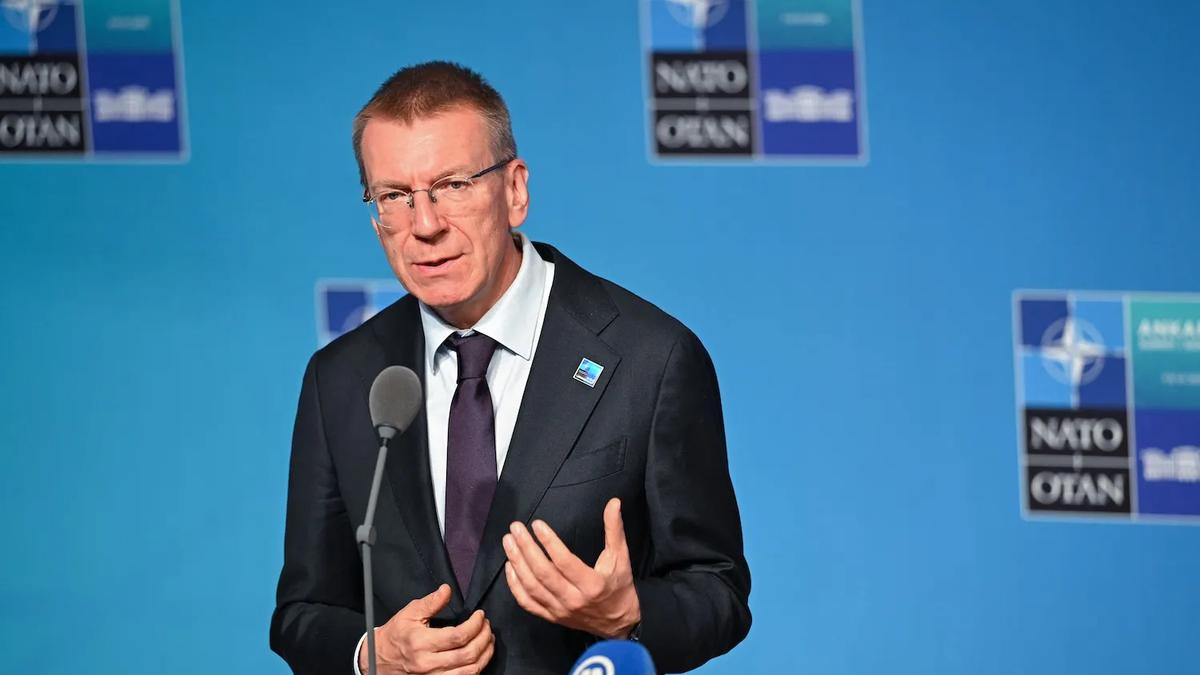
For months, the skies above Latvia have become an inadvertent battleground. Ukrainian drones, knocked off course by sophisticated Russian electronic warfare, have strayed into Latvian airspace, with at least two striking the country in May. These incidents, coupled with a broader pattern of suspected Russian sabotage—including a failed drone attack in Germany and arson in Estonia—signal a deliberate escalation of 'gray zone' tactics against NATO members. Latvian President Edgars Rinkevics has voiced growing alarm, highlighting Russia's increasing appetite for risk and the profound challenge these actions pose to NATO's collective defense doctrine.
Russia's strategy is a calculated probe of NATO's unity and resolve, designed to exploit the alliance's internal mechanisms without triggering a direct military response. By using electronic warfare to redirect drones or orchestrating sabotage through proxies, Moscow creates incidents that are difficult to definitively attribute within the 24-hour window often needed for a robust response. This ambiguity is key: it allows Russia to inflict low-level damage, sow discord, and test NATO's Article 5 commitment—which states an attack on one is an attack on all—without providing clear, undeniable proof that would compel a unified military retaliation. The goal is to demonstrate that NATO's collective defense might not be as automatic or unified as its members hope, especially when the 'attack' is subtle, deniable, and below the traditional threshold of armed aggression. This approach also serves as a compensatory measure for Russia's struggles on the Ukrainian battlefield and its domestic economic pressures, projecting strength and creating instability among its adversaries at a relatively low cost.
The most immediate human cost falls on the citizens of frontline states like Latvia. Communities in eastern Latvia, bordering Russia, live with the constant threat of stray drones and the psychological burden of a war that feels increasingly close. While public support for Ukraine remains strong, the daily reality of air raid alerts, the economic strain of high energy prices, and the mandated 5% defense spending weigh heavily. The resignation of Latvia's prime minister after drone strikes underscores the political instability these incidents can generate. Beyond the direct impact, there's the broader erosion of security and trust across Europe. Citizens in Germany, Estonia, and Poland now face the unsettling prospect of covert attacks, creating a pervasive sense of vulnerability and anxiety. This 'invisible' conflict forces ordinary people to bear the psychological and economic costs of a geopolitical struggle they did not choose, diverting resources and attention from domestic needs towards an ever-present external threat.
What powerful actors are downplaying or omitting is the profound internal debate within NATO regarding the threshold for Article 5. While NATO doctrine acknowledges that sabotage leading to casualties *may* trigger Article 5, the practicalities of proving Russian involvement in a timely and unequivocal manner are immensely complex. Governments are hesitant to commit to a military response without irrefutable evidence, fearing either an unwarranted escalation or a perceived lack of unity if some allies demand more proof than others. This creates a dangerous gray area that Russia is expertly exploiting. The unspoken truth is that the alliance's strength lies in its cohesion, and these ambiguous attacks are designed to fracture that cohesion by forcing members to publicly deliberate the very definition of an 'attack.' Furthermore, the long-term economic dependencies, particularly in countries like Germany, on Russian energy or trade, even if diminished, still influence the appetite for a forceful response, a factor rarely highlighted in official statements.
Moving forward, several critical developments bear watching. The effectiveness of Ukraine's anti-drone specialists, now deployed in Latvia, will be a key indicator of whether these 'accidental' incursions can be mitigated. More broadly, observers should monitor NATO's ability to develop faster, more robust attribution mechanisms for hybrid attacks. How Article 4 consultations—which allow members to bring any issue of concern to the alliance—are utilized and whether they lead to stronger, unified non-military responses will be crucial. The upcoming Latvian parliamentary elections in October will also serve as a test of Russia's hybrid warfare capabilities, particularly in cyberattacks and information operations. Ultimately, the world needs to watch for any incident that provides undeniable proof of direct Russian state-sponsored sabotage leading to significant casualties, as this would force NATO to confront its Article 5 dilemma head-on and potentially redefine the boundaries of modern warfare. The question is not if Russia will continue to probe, but how long NATO can navigate this invisible front line without a clear, unified doctrine for response.
Source referenced: FOREIGNPOLICY
This brief was synthesized by our Editorial Engine and reviewed by The Ground Narrative team.


