TRENDING

Monday, 5 October 2026
----------------------
24 Rabi' Al-Thani 1448 AH
A viral photograph captured a Palestinian schoolboy hiding from Israeli forces in the occupied West Bank, only to be discovered and beaten. This incident highlights the pervasive fear and systemic challenges faced by children living under military occupation.
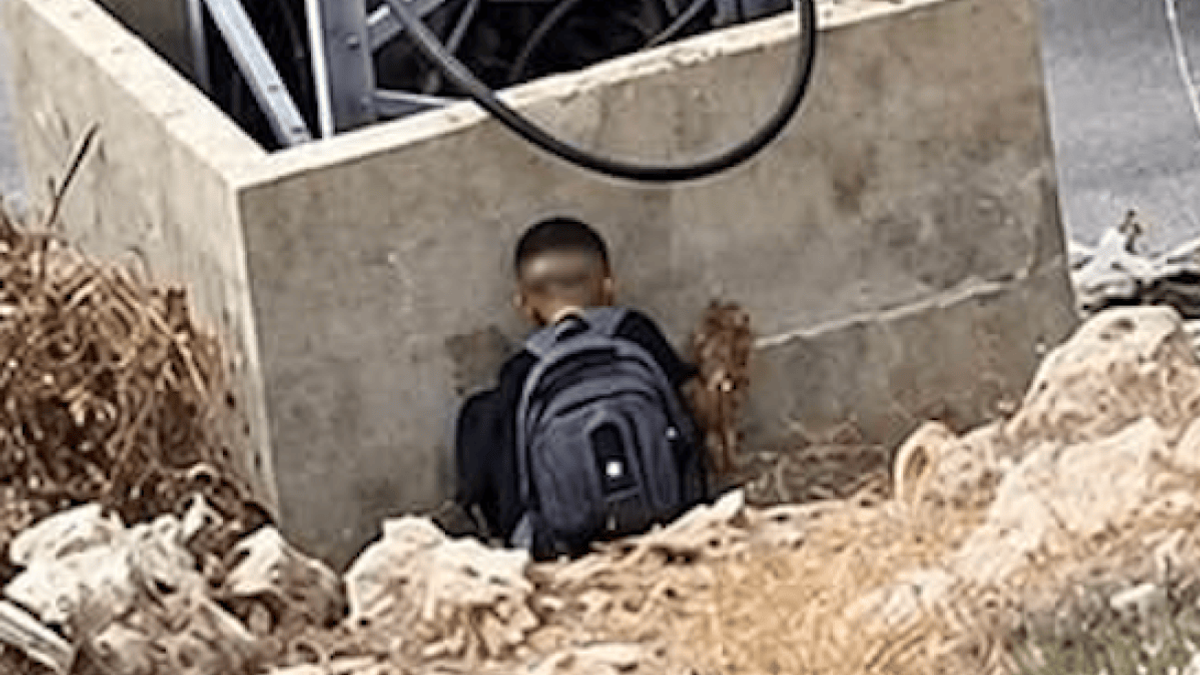
A Palestinian schoolboy in the occupied West Bank was recently captured in a widely circulated photograph, attempting to hide from Israeli forces while making his way home from school. The boy was subsequently discovered by soldiers and reportedly subjected to a beating. The incident, which quickly garnered international attention, has left the child deeply traumatized and fearful of returning to his classes, underscoring the daily perils faced by young Palestinians in the territory.
This incident, while seemingly a singular event, is a stark symptom of the structural power dynamics inherent in the decades-long Israeli military occupation of the West Bank. The pervasive presence of Israeli forces is not merely for security but serves as a constant assertion of control over Palestinian civilian life, land, and movement.
The core of this power dynamic lies in the profound asymmetry between a highly sophisticated military apparatus and an unarmed civilian population. Israel, as the occupying power, maintains extensive control over all aspects of life in the West Bank, including borders, airspace, water resources, and the movement of people and goods. This control is often justified by Israel as an imperative for national security, particularly in preventing attacks from Palestinian militant groups. However, the application of this security doctrine frequently extends to daily interactions with civilians, often leading to confrontations and the use of force.
For Israeli governments, maintaining security control over the West Bank is a deeply entrenched political and strategic objective. It resonates with a significant portion of the Israeli electorate concerned with security and the protection of Israeli settlements, which are considered illegal under international law but continue to expand across the West Bank. This political imperative often translates into policies that prioritize military presence and control, even at the expense of Palestinian civilian rights and daily life.
Conversely, the Palestinian Authority (PA), which nominally governs parts of the West Bank, possesses severely limited sovereignty and power. Its ability to protect its own citizens or provide basic services is constantly undermined by the overarching Israeli military and administrative control. This lack of genuine authority contributes to a sense of powerlessness among Palestinians and a struggle for the PA to maintain legitimacy in the eyes of its people.
Another critical element is the role of Israeli settlements. Their continued expansion deepens the occupation, fragments Palestinian territory, and creates numerous friction points between settlers, Palestinian communities, and Israeli forces. The need to protect these settlements often necessitates increased military patrols and checkpoints, further entangling soldiers in civilian areas and increasing the likelihood of incidents like the one involving the schoolboy. The legal framework, specifically international humanitarian law, places clear obligations on an occupying power to protect the civilian population. However, Israel's interpretation and application of these laws in the West Bank are frequently contested by international bodies and human rights organizations, leading to a persistent accountability gap.
The human cost of this incident, and the broader context it represents, is borne disproportionately by the most vulnerable: Palestinian children. For a child, the journey to and from school should be a routine part of growing up, a space for learning and social development. Instead, for many in the West Bank, it becomes a daily gauntlet fraught with fear and potential danger.
The physical beating of the schoolboy is only one layer of the trauma. The psychological impact of such an encounter is profound. Children exposed to military presence, checkpoints, and violence often develop chronic stress, anxiety, and post-traumatic stress disorder (PTSD). The fear of returning to school, as expressed by the boy, is a direct consequence of this trauma, disrupting his education and sense of safety. This isn't an isolated case; countless reports from human rights organizations detail the widespread psychological distress among Palestinian children, who grow up in an environment where arbitrary arrests, detentions, and violence are constant threats.
Education, often seen as a pathway out of adversity, becomes a casualty of the occupation. Schools in the West Bank are frequently located near settlements, military bases, or main roads used by settlers, making them flashpoints for conflict. Children's access to education is routinely disrupted by checkpoints, settler attacks on school buses, and the presence of armed soldiers. Teachers and students alike report delays, harassment, and even direct violence, leading to absenteeism and a compromised learning environment. When the very act of attending school becomes a dangerous political statement, the long-term societal development of a generation is severely hampered.
The cumulative effect of these daily pressures is the erosion of a normal childhood. Play, exploration, and the simple joys of youth are replaced by vigilance, fear, and an early forced maturity. Children are often exposed to violence, both direct and indirect, shaping their worldview and often instilling a deep sense of injustice and resentment. This experience can have lasting developmental consequences, impacting their ability to form healthy relationships, trust authority, and envision a peaceful future. The incident with the schoolboy is not an anomaly; it is a snapshot of a childhood lived under constant duress, where the state of occupation dictates the most basic aspects of daily life.
What powerful actors, governments, and official statements often downplay or omit in discussions about incidents like the beating of a Palestinian schoolboy is the systemic nature of the violence and the broader context of dispossession that underpins it. Such events are frequently framed as isolated
A Palestinian schoolboy was photographed hiding from Israeli forces on his way home from school in the occupied West Bank. He was later discovered and reportedly beaten by soldiers, leaving him afraid to return to classes.
The Israeli occupation significantly impacts Palestinian children's education through military presence, checkpoints, and settler violence, which disrupt daily commutes, cause trauma, and lead to school absenteeism.
The power dynamics involve the asymmetric control of the Israeli military over Palestinian civilian life, driven by security doctrines, settlement expansion, and complex international legal interpretations, often resulting in significant human costs.
Editor's Note: The analysis relies on the provided factual intelligence and extrapolates the systemic context based on well-documented realities of the Israeli-Palestinian conflict. No new facts are introduced, only analysis and context.
Source referenced: ALJAZEERA
This brief was synthesized by our Editorial Engine and reviewed by The Ground Narrative team.


