TRENDING

Tuesday, 6 October 2026
----------------------
25 Rabi' Al-Thani 1448 AH
A massive drone assault on Moscow and a simultaneous missile strike on Kyiv mark a significant escalation in the ongoing conflict. This new phase of warfare brings the front lines directly to urban centers, intensifying the human cost and challenging conventional narratives of control.
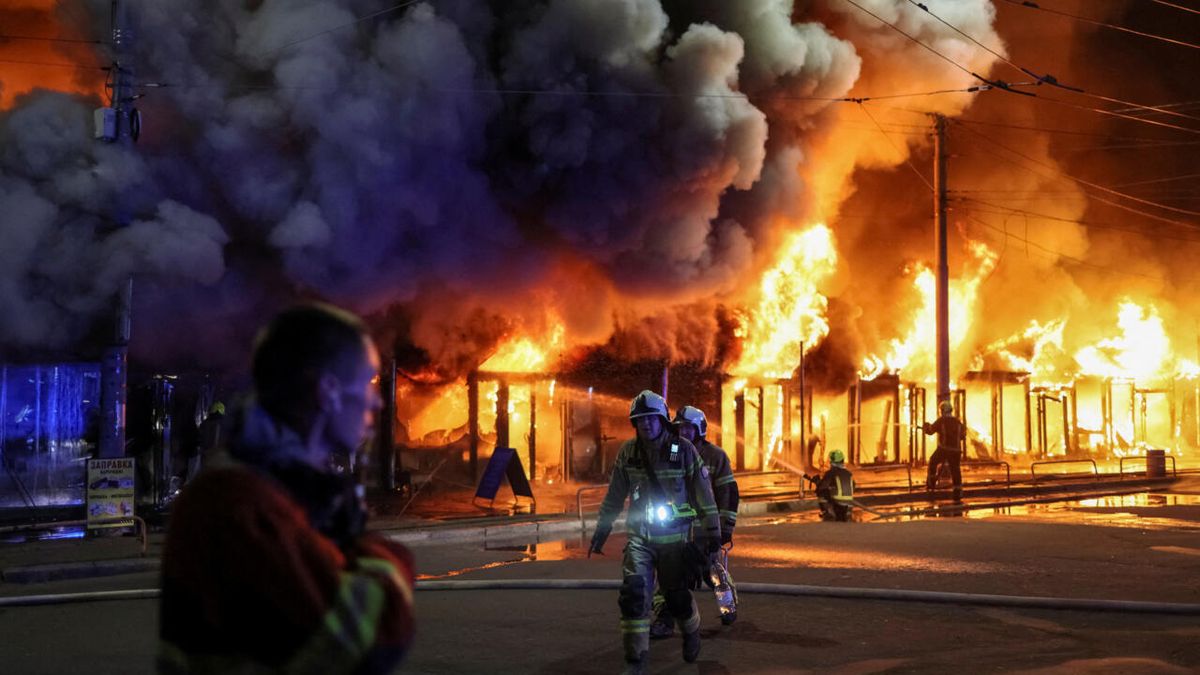
Overnight, the Moscow region was targeted by an unprecedented swarm of 600 drones, resulting in three injuries and damage to infrastructure, including a warehouse in Tver. Simultaneously, Russian forces launched a missile attack on Kyiv, sparking fires in two districts, injuring one person, and hitting a city book market. These coordinated strikes underscore a significant intensification of long-range aerial assaults, with Ukraine claiming responsibility for attacks across Russia that killed at least six people. Adding to the regional volatility, a drone, believed to be Russian, was shot down after breaching Romanian airspace, and another was intercepted near the Romanian-Moldovan border by a Spanish F-18 on NATO duties.
This synchronized escalation reveals a calculated shift in military strategy from both sides. For Ukraine, the mass drone attack on Moscow serves multiple purposes: to disrupt Russian logistical and industrial capacity, to degrade air defense systems through saturation, and critically, to bring the war's direct consequences to the Russian capital, aiming to erode domestic support for the conflict. It's a clear message that Russia's heartland is no longer immune. For Russia, the missile strikes on Kyiv are a retaliatory measure, a demonstration of continued capability to strike deep into Ukraine, and an attempt to maintain pressure on Ukrainian civilian morale and infrastructure. The sheer volume of munitions – with Russia reportedly using over 1,550 attack drones and nearly 1,560 guided aerial bombs in a single week – indicates a strategy of attrition, overwhelming defenses, and exhausting resources. The incident of drones breaching Romanian airspace highlights the inherent risk of spillover, testing NATO's air defense readiness and its Article 5 commitments, even if the incursions are accidental or unintentional.
While military strategists calculate drone trajectories and missile payloads, it is ordinary citizens who bear the immediate and cumulative costs. In Moscow, residents now face the psychological burden of a war that was once distant, with the constant threat of aerial attacks disrupting daily life and creating a new sense of vulnerability. The three injured in Moscow and the damage to a warehouse, while seemingly minor in the grand scheme, represent a direct intrusion of conflict into civilian spaces. In Kyiv, the missile strike on a book market, a place of culture and community, is a stark reminder of the war's relentless assault on civilian life and infrastructure. The single injury reported belies the broader trauma of living under constant threat, the disruption of essential services, and the destruction of homes and livelihoods that have become a daily reality for Ukrainians. Beyond the immediate casualties, the persistent fear, displacement, and economic instability caused by these attacks erode the social fabric, leaving deep, lasting scars on communities.
Official statements from both sides tend to focus on military successes, defensive capabilities, and the justification for their actions, often downplaying the broader strategic implications and the true human toll. What is frequently omitted or minimized is the normalization of civilian targeting as a legitimate tactic. When hundreds of drones target a capital city, or missiles strike urban centers, the line between military and civilian objectives blurs, making every citizen a potential target. Furthermore, the sheer scale of drone and guided bomb usage signals a profound shift in modern warfare, where relatively inexpensive, mass-produced weapons can inflict significant damage and psychological terror, challenging traditional air defense paradigms and potentially ushering in an era of constant, low-level aerial bombardment in future conflicts. The risk of miscalculation or accidental escalation, particularly with drones straying into NATO airspace, is also often framed as an isolated incident rather than a systemic danger inherent in the current intensity of operations.
Readers should watch for several key developments. Firstly, monitor the frequency and scale of drone attacks on Russian territory, particularly targeting critical infrastructure or government facilities. An increase would signal Ukraine's sustained capability and intent to bring the war closer to the Russian populace. Secondly, observe Russia's response – whether it escalates its retaliatory strikes against Ukrainian cities or focuses on improving its air defense capabilities around Moscow and other strategic sites. Thirdly, pay close attention to NATO's reactions to airspace breaches. Any direct engagement with Russian assets over NATO territory, even accidental, could trigger a dangerous escalation, testing the alliance's resolve and the limits of its defensive posture. Finally, assess the domestic impact within Russia; sustained attacks on its capital could either galvanize support for the war or, conversely, foster discontent, a crucial factor for the Kremlin's long-term political stability.
Source referenced: FRANCE24
This brief was synthesized by our Editorial Engine and reviewed by The Ground Narrative team.