TRENDING

Monday, 5 October 2026
----------------------
24 Rabi' Al-Thani 1448 AH
Turkey, Saudi Arabia, and Pakistan have signed a historic defense pact, aiming to strengthen collective deterrence against aggression in the region. The agreement is seen as a deterrent, particularly against Iran and Israel, and marks a significant shift in regional alliances.
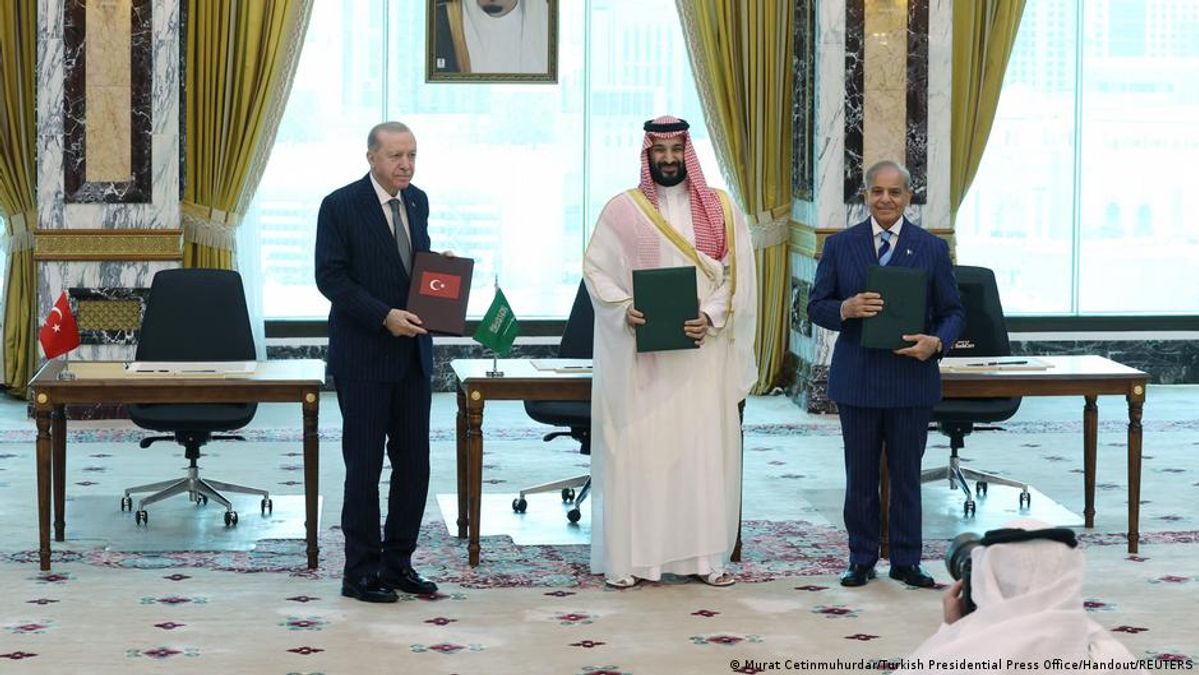
The Mecca Joint Defense Agreement was signed by Turkey's President Recep Tayyip Erdogan, Saudi Crown Prince Mohammed bin Salman, and Pakistan's Prime Minister Shehbaz Sharif. The pact aims to increase cooperation and strengthen collective deterrence against any act of aggression, particularly in the context of regional uncertainty and threats from the Iran war.
The agreement is part of a broader strategy by Saudi Arabia to bolster its defenses in the face of growing tensions with Iran. Turkey and Pakistan, with their strong armed forces and defense-industrial capabilities, complement Saudi Arabia's oil wealth. The pact is also seen as a way for Saudi Arabia to reduce its reliance on the US for defense. Meanwhile, Turkey and Pakistan stand to gain from the agreement through increased investment and technology transfer.
The people of Yemen, who have been caught in the crossfire of the conflict between Saudi Arabia and the Houthi rebels, will likely continue to bear the brunt of the violence. The Houthi attack on Saudi Arabian oil facilities in Jizan is a stark reminder of the ongoing conflict and the human cost of the war. The pact may also have implications for the people of Iran, who are already suffering under the weight of economic sanctions and military attacks.
What is being downplayed by the signatories to the agreement is the fact that it is unlikely to work as a traditional NATO-style alliance, where an attack on one member is considered an attack on all. The reality is that Turkey and Pakistan have their own interests and relationships with Iran, and are unlikely to automatically come to Saudi Arabia's defense in the event of an attack. Furthermore, the agreement does not address the underlying issues driving the conflict, such as the rivalry between Saudi Arabia and Iran, and the role of external powers like the US and Israel.
As the Mecca pact unfolds, it will be important to watch how the agreement plays out in practice, particularly in the event of an attack on one of the signatory countries. Will Turkey and Pakistan come to Saudi Arabia's defense, or will they prioritize their own interests and relationships with Iran? How will the agreement impact the broader regional dynamics, particularly the rivalry between Saudi Arabia and Iran, and the role of external powers like the US and Israel? The answers to these questions will have significant implications for the people of the region and the global community at large.
Editor's Note: The analysis is based on publicly available information and may not reflect the full complexity of the situation on the ground.
Source referenced: DW
This brief was synthesized by our Editorial Engine and reviewed by The Ground Narrative team.


