TRENDING

Monday, 5 October 2026
----------------------
24 Rabi' Al-Thani 1448 AH
Iran's capital, Tehran, witnessed a massive funeral procession for the late Supreme Leader Ayatollah Ali Khamenei, whose death in US-Israeli air attacks marks a profound escalation in regional tensions. This event triggers a complex succession process within Iran and signals a new, perilous chapter in Middle East geopolitics.
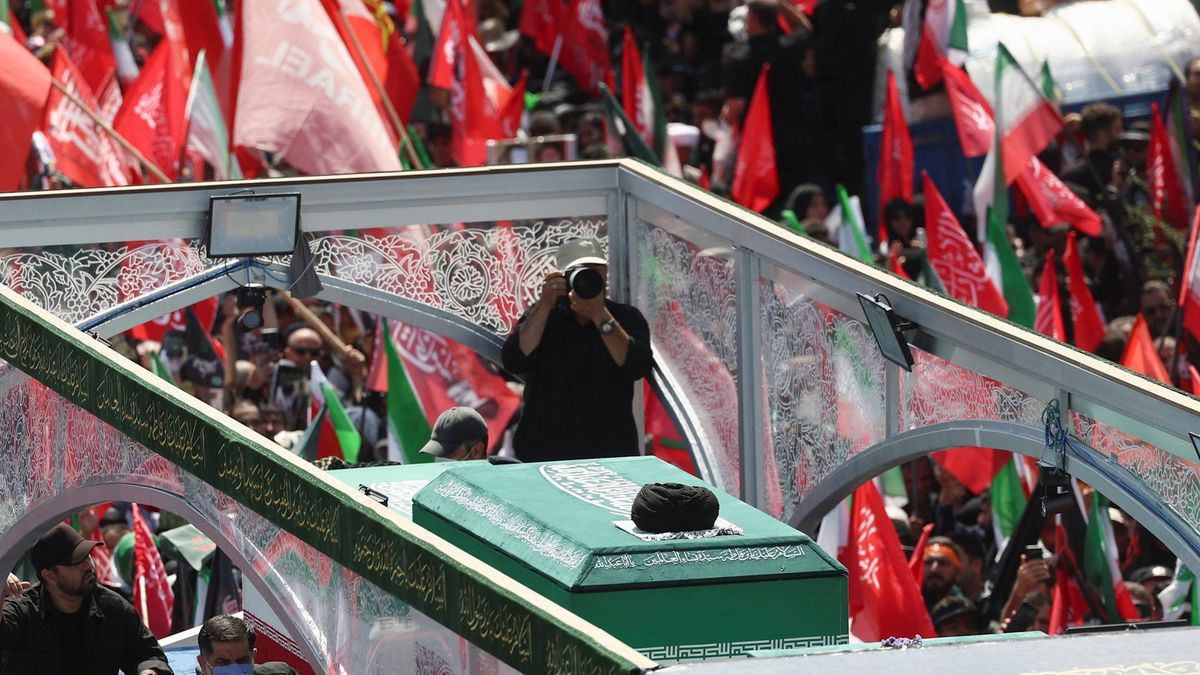
On July 6, 2026, the streets of Tehran were filled with immense crowds as the funeral procession for Iran's Supreme Leader, Ayatollah Ali Khamenei, commenced. This week-long period of national mourning and ceremonial events follows the unprecedented death of the spiritual and political head of the Islamic Republic, who, according to reports, was killed in US-Israeli air attacks in February of the same year. The sheer scale of public attendance, whether spontaneous or state-orchestrated, underscores the profound national significance of Khamenei's passing and serves as a powerful display of national unity and resolve in the face of external aggression.
Ayatollah Khamenei, who had served as Supreme Leader since 1989, was a pivotal figure in shaping Iran's domestic and foreign policies, guiding the nation through decades of complex regional and international challenges. His death, particularly under such circumstances, represents not merely the end of an era but a dramatic inflection point for Iran and the broader Middle East. The funeral, therefore, is more than a solemn religious rite; it is a critical moment of national consolidation and a public demonstration of strength amidst a period of profound uncertainty.
The reported cause of Ayatollah Khamenei's death—US-Israeli air attacks—is a development of immense geopolitical consequence. This event signifies an unprecedented escalation in the long-standing, often covert, conflict between Iran and its adversaries, primarily the United States and Israel. While the specifics of the alleged attacks remain largely unelaborated in the immediate reporting, the implication of such a direct strike against the highest authority of a sovereign nation carries profound implications for regional stability and international law.
Historically, the US and Israel have engaged in various forms of pressure against Iran, including sanctions, cyber warfare, and targeted strikes against military figures or nuclear scientists. However, a direct attack resulting in the death of the Supreme Leader represents a qualitative shift, moving beyond proxy conflicts and limited engagements into a realm of direct, high-stakes confrontation. This act is likely to be perceived by Tehran as an existential threat, demanding a significant response, thereby raising the specter of widespread regional conflict. The immediate aftermath will likely see heightened military alerts across the region, increased activity by Iran's network of proxy forces, and intense diplomatic maneuvering to either de-escalate or further leverage the crisis.
The death of the Supreme Leader triggers a constitutionally defined, yet inherently complex and sensitive, succession process within Iran. The Assembly of Experts, a body of 88 clerics, is tasked with selecting the next Supreme Leader. This process is not merely a formal procedure but a critical juncture that will determine the future ideological and political trajectory of the Islamic Republic. The selection of a successor will involve intricate power dynamics among various factions within the clerical establishment, the Islamic Revolutionary Guard Corps (IRGC), and other influential political blocs.
The new Supreme Leader will inherit a nation grappling with significant internal and external pressures. Domestically, economic challenges, social unrest, and the need to maintain national cohesion will be paramount. Internationally, the successor will face the immediate challenge of responding to the circumstances of Khamenei's death, managing relations with regional adversaries, and navigating the complexities of Iran's nuclear program and its standing on the global stage. The choice of successor will signal whether Iran intends to pursue a path of continuity, reform, or a more hardline stance, with profound implications for its foreign policy and regional posture.
The killing of Ayatollah Khamenei in US-Israeli air attacks is not merely a regional event; it has significant global repercussions. Major world powers, including Russia, China, and European nations, will be closely monitoring the situation, as any further escalation could destabilize global energy markets, disrupt international trade routes, and potentially draw in other actors. The incident challenges existing international norms regarding state sovereignty and the use of force, potentially setting dangerous precedents.
In the immediate term, the international community will be focused on preventing a full-scale war in the Middle East. Diplomatic efforts, both overt and covert, will likely intensify to manage the crisis. However, the deep-seated animosities and strategic imperatives of the involved parties make a swift de-escalation challenging. The long-term implications include a potential re-evaluation of security architectures in the Middle East, a renewed focus on Iran's nuclear capabilities, and a re-calibration of alliances and rivalries across the globe. The funeral procession in Tehran, therefore, serves as a somber prelude to a period of intense geopolitical flux, the full consequences of which are yet to unfold.
Source referenced: ALJAZEERA
This brief was synthesized by our Editorial Engine and reviewed by The Ground Narrative team.


