TRENDING

Monday, 5 October 2026
----------------------
24 Rabi' Al-Thani 1448 AH
A new report details the catastrophic living conditions for nearly two million displaced Palestinians in Gaza, revealing how an expanding Israeli-controlled 'Yellow Line' is systematically shrinking the territory available for civilian life and aid. This ongoing displacement, nearly three years into the conflict, highlights the failure of a supposed ceasefire to alleviate human suffering.
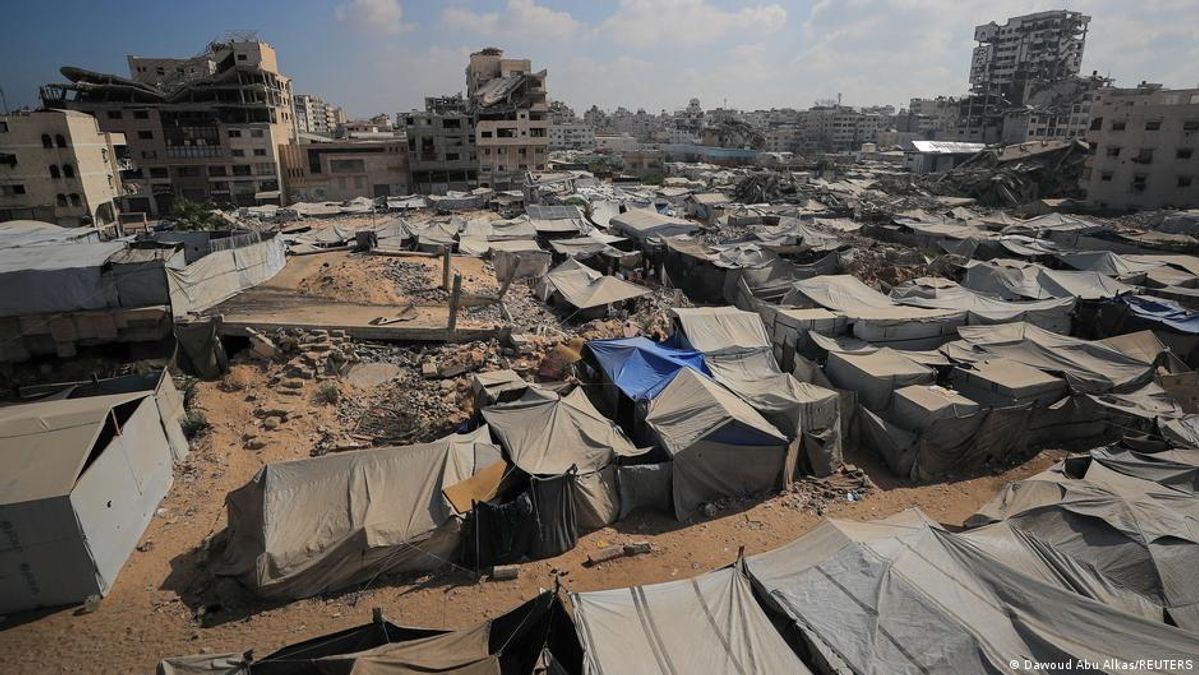
The Danish Refugee Council (DRC) has released a report detailing the catastrophic conditions faced by 1.8 million displaced Palestinians in Gaza, representing 86% of the population. The report, published nearly three years after the conflict began and a year after a supposed ceasefire, highlights inhumane living standards in makeshift camps and accuses Israel of a "policy of protracted displacement" through the expansion of its military-controlled "Yellow Line." This line, demarcating a restricted zone in eastern Gaza, is reportedly creeping westward, effectively confining the population to a fraction of the strip's territory.
The expansion of the "Yellow Line" is not merely a geographic shift; it is a clear demonstration of Israel's evolving security doctrine and its assertion of control over Gaza's territory post-conflict. By systematically expanding this buffer zone, Israel aims to create a more secure perimeter against future attacks, pushing Palestinian population centers further from its border. This strategy serves multiple objectives: military deterrence, control over potential infiltration routes, and potentially, a long-term redefinition of Gaza's viable civilian space. The Israeli government's acknowledgment of this expansion, even with differing figures on the exact percentage, underscores a deliberate policy. For Israel, this territorial control is framed as a matter of national security and a necessary consequence of the ongoing conflict, ensuring that any future Palestinian entity in Gaza operates within significantly constrained geographical and operational limits. The "ceasefire" referenced in the report appears to be a de-escalation of overt hostilities rather than a return to pre-conflict status quo, allowing Israel to consolidate territorial gains and reshape the physical landscape of Gaza. The declining international donor interest, as noted by the DRC, further empowers this dynamic, reducing external pressure on Israel to alter its course.
The most immediate and devastating cost falls upon the 1.8 million Palestinians living in displacement camps, who are now squeezed into a rapidly shrinking habitable zone. Their daily existence is defined by a severe lack of basic necessities: 80% face water shortages, multiple families share single latrines, leading to increased risks of gender-based violence, and rat infestations are rampant. Food scarcity, inadequate medical facilities, and the complete absence of formal education for children are creating a lost generation and a public health crisis. The constant threat of artillery strikes, drones, and unexploded ordnance means even the camps are not safe havens, contributing to severe mental health deterioration, particularly among adult males. This protracted displacement is not just a temporary inconvenience; it is a systematic dismantling of social structures, a denial of dignity, and a severe blow to the physical and psychological well-being of an entire population, with women and children bearing a disproportionate burden of the unsanitary and insecure conditions.
What is largely omitted from official statements and often downplayed in international discourse is the long-term strategic objective behind the "Yellow Line" expansion. While framed as a security imperative, its westward creep suggests a de facto annexation of significant portions of Gaza, fundamentally altering the future viability of the strip as a self-sustaining Palestinian entity. Governments and international bodies often focus on humanitarian aid delivery, which is critical, but less on the structural changes being imposed on the ground that render such aid perpetually necessary. The "dual-use" restrictions on aid items—medical supplies, water, sanitation equipment, fuel—are presented as security measures, but they effectively cripple the capacity for self-recovery and reconstruction, cementing dependence and preventing the establishment of sustainable living conditions. Furthermore, the report's mention of declining political and donor interest highlights a dangerous normalization of the crisis, allowing the powerful actors to continue their policies with less scrutiny and accountability. The lack of transparent disclosure regarding the Yellow Line's current and future route, despite calls from NGOs, underscores this deliberate opacity.
Observers should closely monitor the continued expansion of the "Yellow Line" and any official or unofficial statements from Israel regarding its permanence or future trajectory. The international community's response, particularly regarding the DRC's recommendations for a UN monitoring mechanism and an end to dual-use restrictions, will be crucial. Pay attention to whether humanitarian access improves or further deteriorates, especially in areas near the expanding line, and if any significant pressure is applied on Israel to disclose its territorial plans. The long-term implications for Gaza's governance and reconstruction will depend heavily on whether this de facto territorial reduction is challenged or implicitly accepted, shaping the future of millions of Palestinians and the prospects for any lasting political resolution. The sustained decline in donor interest could also lead to a further collapse of basic services, exacerbating the humanitarian catastrophe.
Editor's Note: The raw intelligence's future dating (e.g., 'October 2025 ceasefire', '09/05/2026') is unusual. The analysis proceeds as if the report's content is current factual intelligence, assuming the user desires an analysis of the events described as if they are happening now, despite the source article's internal dating.
Source referenced: DW
This brief was synthesized by our Editorial Engine and reviewed by The Ground Narrative team.


