TRENDING

Monday, 9 November 2026
----------------------
29 Jumada Al-Awwal 1448 AH
Gabonese President Brice Clotaire Oligui Nguema laid a wreath in Beijing, marking a significant diplomatic engagement following his ascent to power via a military coup. This visit signals a potential reorientation of Gabon's international alliances and economic partnerships.
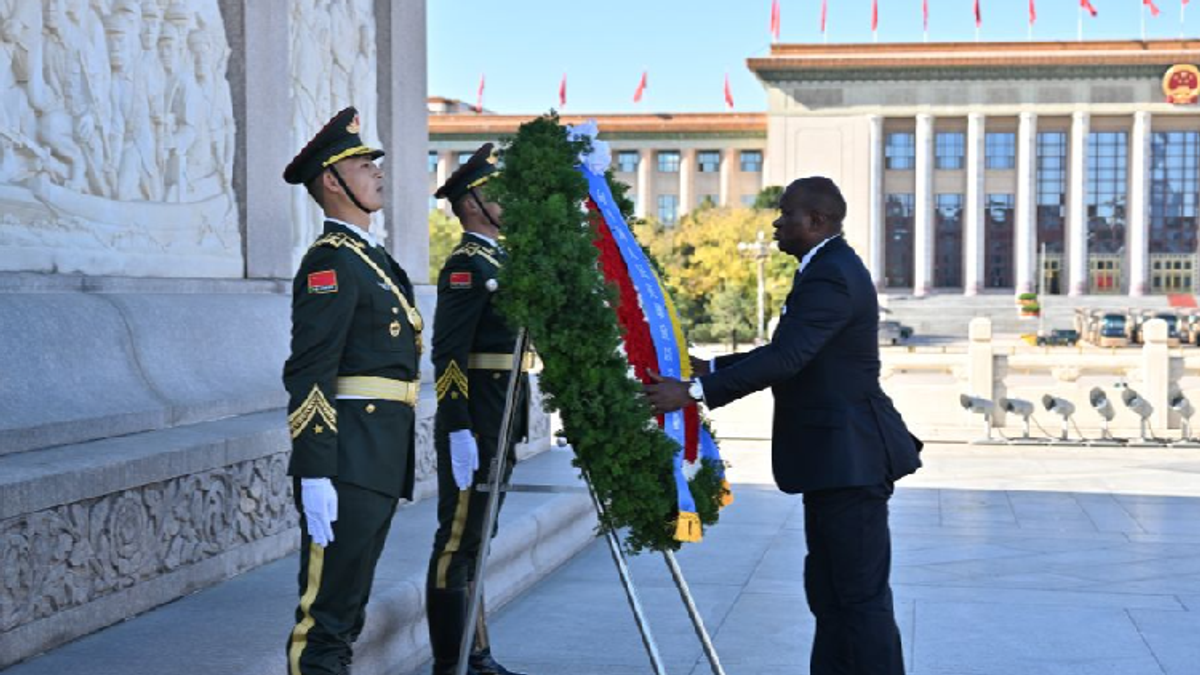
On November 6, 2026, Gabonese President Brice Clotaire Oligui Nguema performed a symbolic act of statecraft, laying a wreath at the Monument to the People's Heroes in Tiananmen Square, Beijing. This ceremonial gesture was a key highlight of his official visit to China, marking his first significant international trip to a non-African global power since assuming control of Gabon through a military coup in August 2023. The visit signifies a formal diplomatic engagement between the new Gabonese leadership and Beijing, following a period of international uncertainty and condemnation that typically follows an unconstitutional change of government.
President Oligui Nguema's visit to Beijing is a masterclass in post-coup power consolidation and strategic reorientation for Gabon, while simultaneously serving China's long-term geopolitical ambitions in Africa. The backdrop to this visit is the August 2023 coup that ended the Bongo family's 56-year dynastic rule, an event initially met with a mix of public relief in Gabon and international condemnation, particularly from Western powers.
China's engagement with the new Gabonese regime is rooted in its long-standing foreign policy doctrine of non-interference in the internal affairs of sovereign states. This principle allows Beijing to engage with governments regardless of their origins, offering a pragmatic alternative to Western nations that often tie diplomatic recognition and economic aid to democratic conditionalities or human rights benchmarks. For a leader like Oligui Nguema, who seized power unconstitutionally, China presents a crucial avenue for securing international legitimacy and economic support without the ideological baggage or demands for immediate democratic transitions that might come from Europe or the United States.
At its core, the relationship is driven by resource diplomacy. Gabon is a resource-rich nation, boasting significant reserves of oil, manganese, and timber. China, as the world's largest consumer of raw materials and a global manufacturing hub, has a voracious appetite for these resources. This visit likely serves to solidify existing resource agreements, potentially renegotiate terms, or pave the way for new investment in Gabon's extractive industries. For Gabon, this translates into much-needed capital and infrastructure development, often financed through Chinese loans.
For Oligui Nguema's nascent regime, the visit is a strategic move to diversify Gabon's international alliances beyond its traditional, often neocolonial, ties with France and the European Union. By engaging with Beijing, Gabon aims to reduce its historical dependence on Western powers, gain greater leverage in international negotiations, and project an image of a sovereign nation charting its own course. This diversification is critical for the survival and stability of a regime seeking to establish itself on the global stage.
From China's perspective, the engagement with Gabon is a calculated step in its broader Africa strategy. Beijing seeks to expand its economic footprint, secure critical supply chains, and build diplomatic alliances across the continent. By embracing new leaders, even those who come to power through coups, China positions itself as a reliable partner, ready to fill any void left by hesitant or sanctioning Western powers. This approach allows China to strengthen its influence and challenge the traditional geopolitical order in Africa.
Beyond economics, China has also been steadily expanding its security cooperation in Africa, offering military training, equipment sales, and intelligence sharing. While not explicitly stated, this visit could lay the groundwork for future security cooperation, further solidifying the new Gabonese regime's hold on power and potentially enhancing its internal security capabilities. This multifaceted engagement underscores the complex web of interests driving the renewed Gabon-China relationship.
The diplomatic embrace between Gabon's new military leadership and China carries significant implications for the ordinary citizens of Gabon, often overlooked in the grand calculations of geopolitical power. While the immediate focus might be on state-to-state relations and resource deals, the long-term consequences can profoundly impact democratic development, environmental sustainability, and the economic well-being of the population.
While the Bongo regime was widely criticized for its authoritarian tendencies and corruption, the military coup, despite initial public support, replaces one non-democratic system with another. The international recognition and economic backing from a major power like China can inadvertently legitimize the new regime, potentially delaying genuine democratic reforms and limiting the space for citizen participation in governance. The promise of a transition back to civilian rule often remains elusive, with power concentrated in the hands of a few, rather than distributed among the populace.
Gabon's vast natural resources — oil, manganese, and extensive timber reserves — are both its blessing and its curse. Increased resource extraction, often driven by foreign demand, can lead to significant environmental degradation. Local communities, particularly indigenous populations, often bear the brunt of deforestation, pollution from mining operations, and displacement, with little compensation or say in the projects that impact their ancestral lands. The profits from these ventures frequently bypass the general population, enriching political elites and foreign corporations, rather than funding public services or sustainable development.
Chinese loans for large-scale infrastructure projects, while appearing to offer rapid development, can also lead to substantial debt burdens for the Gabonese state. These loans, often tied to resource concessions, risk mortgaging future generations' resources and limiting the country's fiscal autonomy. While the stated goal is to reduce dependency on former colonial powers, Gabon risks trading one form of external influence for another, potentially limiting its policy choices and economic sovereignty in the long run.
Chinese companies operating in Africa have, at times, faced criticism regarding labor practices, worker safety standards, and the employment of local populations versus Chinese expatriates. While official agreements often stipulate local hiring, the reality on the ground can be different, leading to local resentment and missed opportunities for skill transfer and economic empowerment for Gabonese workers.
A regime seeking to consolidate power, especially with robust external backing, may feel emboldened to crack down on dissent, limit civil liberties, and restrict the activities of human rights activists, journalists, and opposition figures. The focus on stability and economic development, often prioritized by external partners, can come at the expense of fundamental freedoms and the protection of human rights.
Behind the diplomatic courtesies and official communiqués surrounding President Oligui Nguema's visit to Beijing lies a more complex narrative, one where powerful actors are carefully crafting perceptions and downplaying underlying strategic imperatives. The official story emphasizes mutual respect and cooperation, but the ground truth reveals deeper power plays and unspoken trade-offs.
Gabon's President Oligui Nguema visited China to gain international legitimacy and economic support following his military coup. China's policy of non-interference makes it a pragmatic partner for regimes seeking to diversify alliances away from traditional Western powers.
China is primarily interested in securing access to Gabon's rich natural resources like oil, manganese, and timber to fuel its industrial growth. The visit also serves to expand China's geopolitical influence and diplomatic alliances across Africa.
While the visit may bring infrastructure development, it also raises concerns about democratic backsliding, increased debt burden, environmental degradation from resource extraction, and potential impacts on labor practices and civil liberties for ordinary Gabonese citizens.
Editor's Note: Analysis is based on established geopolitical patterns of China's engagement in Africa and the typical dynamics following military coups in resource-rich nations.
Source referenced: CGTN
This brief was synthesized by our Editorial Engine and reviewed by The Ground Narrative team.