TRENDING

Monday, 26 October 2026
----------------------
15 Jumada Al-Awwal 1448 AH
North Korean leader Kim Jong Un's recent tribute to Chinese People's Volunteer martyrs underscores the deep historical bonds between Pyongyang and Beijing, signaling a reaffirmation of their strategic alliance amidst evolving regional dynamics. This gesture carries significant geopolitical weight, reflecting shared interests and a united front against perceived external pressures.
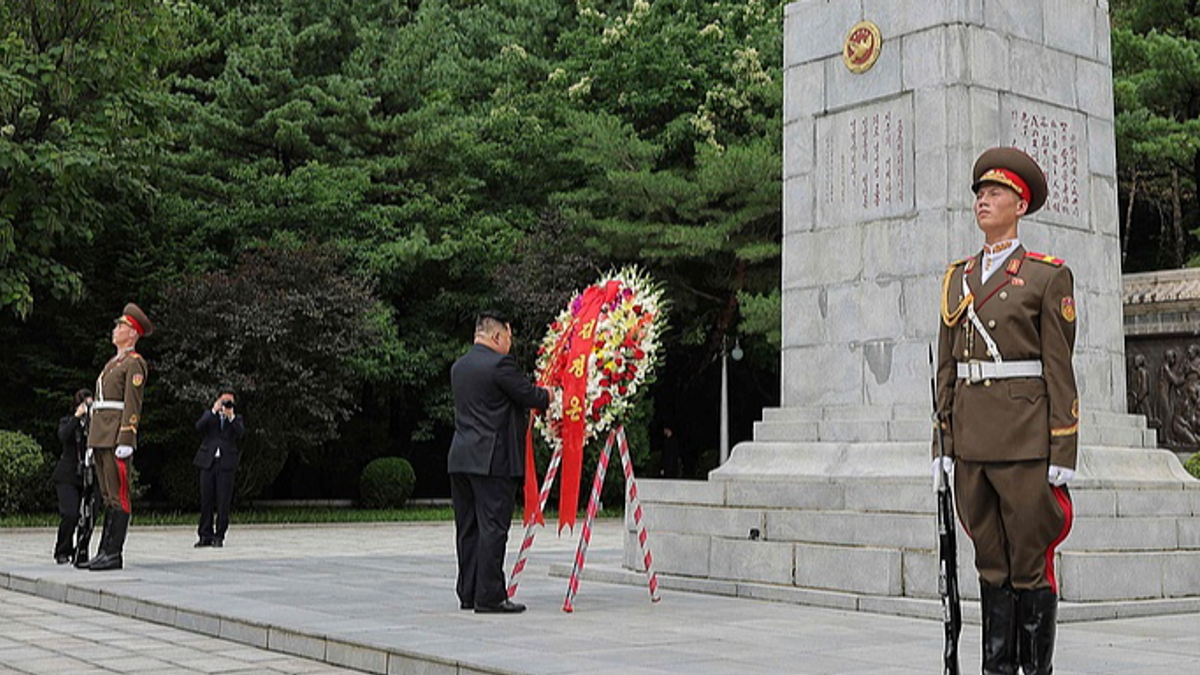
On July 26, 2026, Kim Jong Un, the top leader of the Democratic People's Republic of Korea (DPRK), paid a solemn tribute to the martyrs of the Chinese People's Volunteer (CPV) Army. The ceremony, held at the CPV martyrs' cemetery in Hoechang County, South Phyongan Province, coincided with the 73rd anniversary of what Pyongyang refers to as the 'victory in the Fatherland Liberation War' – the Korean War armistice. This act, reported by the official Korean Central News Agency (KCNA), involved Kim laying a flower at the grave of Mao Anying, son of former Chinese leader Mao Zedong, and a wreath at the monument commemorating the CPV's sacrifices.
This event is far more than a mere historical commemoration; it is a potent geopolitical signal. It underscores the enduring strategic alliance between the DPRK and China, an alliance forged in the crucible of the Korean War (1950-1953). China's intervention, which involved hundreds of thousands of 'volunteers,' was pivotal in preventing the collapse of the nascent North Korean state against the combined forces of the United Nations Command, primarily led by the United States and South Korea. The sacrifice of figures like Mao Anying, who died in combat in Korea, symbolizes the profound cost and commitment China made to secure its strategic interests on the Korean Peninsula and support its communist ally.
The timing and nature of Kim Jong Un's tribute are strategically significant. The 73rd anniversary of the armistice serves as a powerful reminder of the historical solidarity that binds Pyongyang and Beijing. For North Korea, this alliance is a cornerstone of its national security, providing a crucial geopolitical counterbalance to the formidable military presence of the United States and its allies in the region, particularly South Korea and Japan. In an era of heightened international sanctions and diplomatic isolation, China remains the DPRK's most vital economic partner and political patron, offering a lifeline that mitigates the impact of global pressure.
From Beijing's perspective, the stability of North Korea and the maintenance of a friendly buffer state on its northeastern border remain paramount. While China has, at times, expressed frustration with Pyongyang's nuclear and missile programs, it consistently prioritizes regional stability and the prevention of a collapse scenario that could lead to a unified, U.S.-allied Korea on its doorstep. Public displays of solidarity, such as this tribute, reinforce China's historical narrative as a protector of its allies and a significant regional power, while also subtly signaling its continued influence over Korean Peninsula affairs.
The reaffirmation of the DPRK-China alliance through such a high-profile gesture carries significant implications for regional security. It sends a clear message to the United States and its allies, particularly South Korea and Japan, about the resilience of this partnership. In recent years, Washington, Seoul, and Tokyo have intensified their trilateral security cooperation, conducting joint military exercises and strengthening intelligence sharing, largely in response to North Korea's escalating missile tests and China's growing assertiveness in the Indo-Pacific. Kim's tribute can be interpreted as a direct counter-signal, demonstrating that Pyongyang is not isolated and can rely on its powerful neighbor.
This enduring alliance complicates efforts by the international community to achieve denuclearization on the Korean Peninsula. With China's implicit backing, North Korea gains a degree of diplomatic leverage and economic resilience, potentially reducing its susceptibility to external pressure. The tribute also reinforces the deeply entrenched Cold War-era divisions that continue to shape East Asian geopolitics, making any comprehensive resolution of inter-Korean tensions or the nuclear issue inherently complex and multi-faceted.
Looking ahead, the DPRK-China relationship is likely to remain a critical determinant of stability in Northeast Asia. While the dynamics may evolve, the historical bonds and shared strategic interests, publicly acknowledged through events like Kim Jong Un's tribute, suggest a continued commitment to mutual support. This alliance will continue to be a key factor in regional power calculations, influencing everything from economic development to military posturing and diplomatic initiatives across the Asia-Pacific.
Source referenced: CGTN
This brief was synthesized by our Editorial Engine and reviewed by The Ground Narrative team.


