TRENDING

Friday, 2 October 2026
----------------------
21 Rabi' Al-Thani 1448 AH
Explosions in Damascus during French President Emmanuel Macron's visit highlight the persistent security challenges in Syria. The incident raises critical questions about the nation's stability and the complexities of international diplomatic engagement.
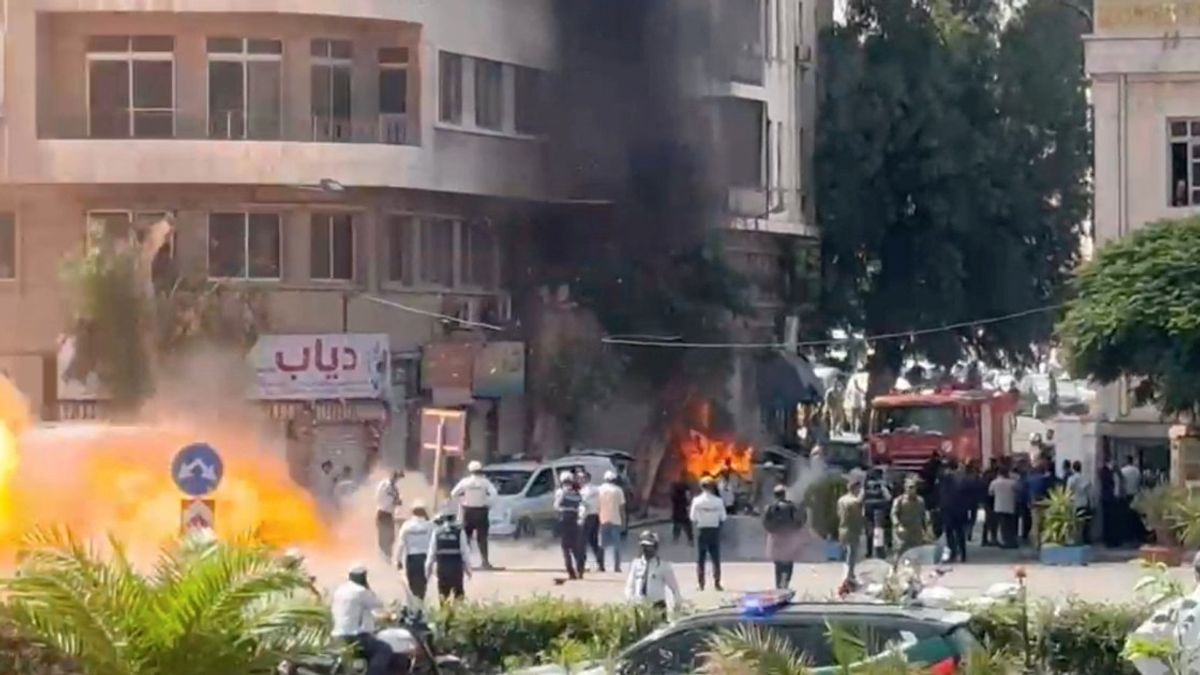
On Tuesday, July 7, 2026, the Syrian capital of Damascus was rocked by at least two explosive devices, an incident that occurred concurrently with a high-profile diplomatic visit by French President Emmanuel Macron. The blasts, which sent plumes of smoke rising over the city, took place in a civilian-dense area, with one explosion reported near the Ministry of Tourism and another close to a hotel where President Macron was reportedly scheduled to stay. While Macron's office confirmed that the president, en route to meet his Syrian counterpart Ahmed al-Sharaa, did not hear the blasts and his visit proceeded as planned, the timing and location of the attacks carry significant geopolitical implications, highlighting the persistent fragility of security in Syria and the complex challenges facing international engagement with the nation.
The immediate aftermath saw Syrian authorities sealing off roads and launching an investigation into what a security official described as a “criminal act,” with fears of casualties. Television footage and verified online content depicted a vehicle engulfed in flames, suggesting the nature of at least one of the explosive devices. This incident follows another recent security breach in Damascus, where an explosion at a cafe just last week claimed the lives of at least nine people and wounded 20 others, according to Syria's Ministry of Health. These successive attacks underscore a troubling pattern of insecurity within the capital, challenging any narrative of a fully stabilized post-conflict environment.
President Macron's visit to Damascus itself represents a notable development in international diplomacy concerning Syria. For years, Western powers, including France, have largely maintained a policy of isolation towards the Syrian government following the brutal suppression of protests that escalated into a protracted civil war. The presence of a sitting French president in Damascus for talks with President al-Sharaa could signal a potential shift in this diplomatic stance, or at least an exploration of new avenues for engagement. Such a visit, regardless of its specific agenda, inherently confers a degree of legitimacy and recognition, which the Syrian government has actively sought from the international community.
France, a permanent member of the UN Security Council and a key player in European foreign policy, has historically held significant interests and influence in the Levant. Its re-engagement, even if exploratory, could have broader implications for the European Union's approach to Syria, potentially paving the way for other nations to reconsider their diplomatic postures. The discussions between Macron and al-Sharaa were likely to cover a range of critical issues, including humanitarian aid, the return of refugees, political transition, and counter-terrorism efforts, all of which are central to regional stability and European security concerns.
The timing of the explosions, coinciding precisely with a high-profile presidential visit, suggests a deliberate attempt to disrupt diplomatic efforts, send a strong message, or even directly target the visiting delegation. While the perpetrators remain unknown, such an act could serve multiple objectives for various actors. It could be an attempt by anti-regime elements or extremist groups to demonstrate the Syrian government's inability to ensure security, even in its own capital, thereby undermining its claims of control and stability. Alternatively, it could be orchestrated by actors seeking to derail any potential rapprochement between Syria and Western nations, viewing such engagement as detrimental to their own strategic interests in the region.
The incident also casts a shadow over the prospects for Syria's reintegration into the international community. Persistent security threats, particularly those targeting diplomatic events, reinforce perceptions of Syria as an unstable and high-risk environment. This could complicate efforts to attract reconstruction aid, facilitate refugee returns, or foster broader economic recovery, all of which are crucial for long-term stability. For France, the incident raises questions about the security environment for future diplomatic missions and the overall efficacy of engaging with a regime that appears unable to fully secure its own capital.
Syria remains a complex geopolitical chessboard, with numerous internal and external actors vying for influence. The presence of Russian and Iranian forces, Turkish military operations in the north, and ongoing Israeli airstrikes against alleged Iranian targets within Syria all contribute to a volatile security landscape. The explosions in Damascus serve as a stark reminder that despite significant territorial gains by the Syrian government and its allies, the underlying causes of instability, including the presence of various armed groups and deep-seated grievances, have not been fully resolved.
The international community, including France, faces a delicate balancing act: how to address the humanitarian crisis and long-term stability of Syria without legitimizing a regime accused of widespread human rights abuses. The Damascus explosions complicate this equation, underscoring that any path forward must contend with a persistent and unpredictable security environment. As investigations proceed, the incident will undoubtedly be scrutinized for clues regarding the identity and motivations of the perpetrators, with potential ramifications for regional security dynamics and the future trajectory of international engagement with Syria. The event highlights that even as diplomatic overtures are made, the ground reality in Syria remains fraught with peril and uncertainty.
Source referenced: ALJAZEERA
This brief was synthesized by our Editorial Engine and reviewed by The Ground Narrative team.

