TRENDING

Thursday, 12 November 2026
----------------------
2 Jumada Al-Thani 1448 AH
A new Al Jazeera documentary shows how a biblical vision of a ‘Greater Israel’ has been turned into lobbying power in Washington. The analysis uncovers who profits, who suffers, and what the next flashpoints may be.
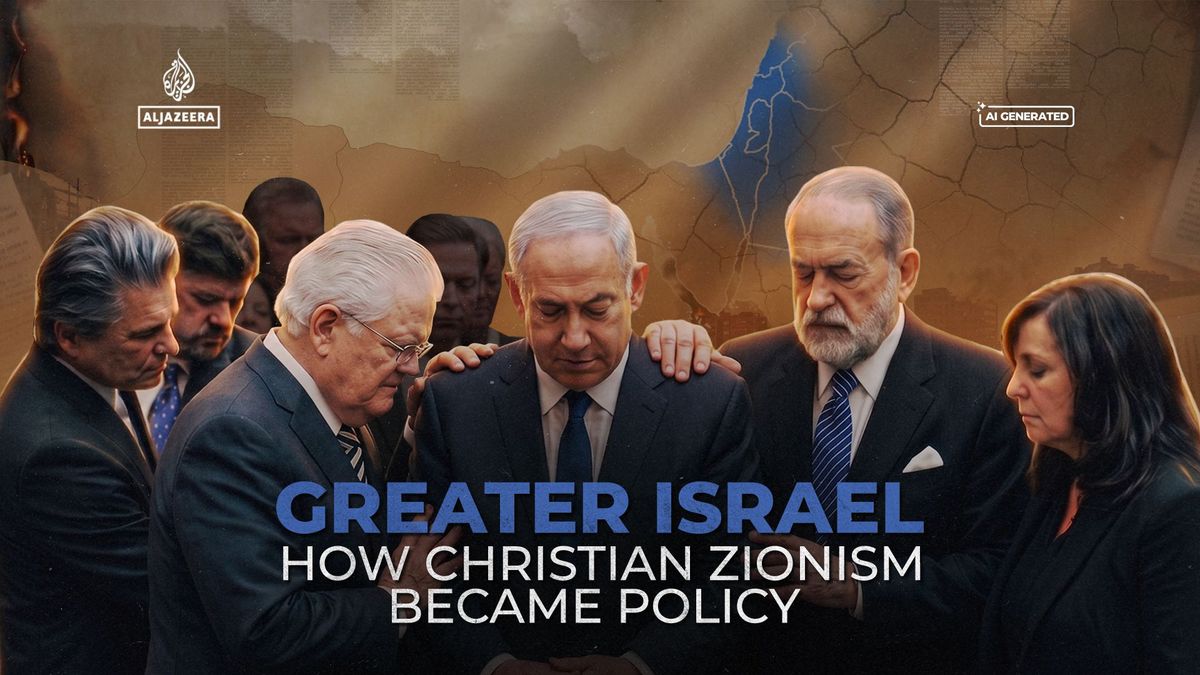
The Al Jazeera documentary *Greater Israel* follows a familiar script: a megachurch sermon, a hand‑drawn map, and a policy shift that turns scripture into land grabs. Pastor John Hagee, founder of Christians United for Israel (CUFI), reads a biblical promise that stretches from the Nile to the Euphrates, then points to a modern political agenda that backs Israeli settlement expansion, Syrian incursions, and a push for annexation. The film links that rhetoric to concrete outcomes – U.S. aid packages, diplomatic backing, and on‑the‑ground military moves that have displaced thousands.
- Electoral weight – White evangelical Protestants make up about 13 % of the U.S. adult population, roughly 44 million voters, and overwhelmingly back Republican candidates. In the 2024 election, 82 % of white evangelicals voted for Donald Trump, giving the bloc a decisive edge in primary contests and shaping the party’s platform on Israel.
- Money and lobbying – The International Fellowship of Christians and Jews has raised over $3.6 billion since 1983, with the vast majority of donors identifying as Christian. CUFI’s political arm, CUFI Action Fund, spent $679,410 on federal lobbying in 2025 alone, targeting aid bills and defense appropriations that keep Israel’s military edge intact.
- Institutional access – Organizations like Capitol Ministries run weekly Bible studies for members of Congress, and during the first Trump administration, a cabinet‑level study was convened. This creates a feedback loop where policy is framed as a divine mandate rather than a geopolitical calculation.
- Israeli alignment – Israeli officials, from Gideon Sa’ar to Finance Minister Bezalel Smotrich, openly cite biblical language when defending settlement projects or annexation plans. The United States, through figures like former ambassador Mike Huckabee, echoes that language, effectively legitimizing territorial claims that exceed internationally recognized borders.
- Strategic depth narrative – Israel’s post‑2024 moves into the Syrian buffer zone and southern Lebanon are presented as “temporary security measures.” The language mirrors the biblical map, turning a religious vision into a justification for expanding the military footprint.
Settlements backed by U.S. aid have swelled from 600,000 in 2020 to over 800,000 in 2026. Palestinian families face home demolitions, loss of agricultural land, and restricted movement. The United Nations reports a 27 % rise in displacement since 2024, with many forced into overcrowded camps that lack basic services.
After the collapse of the Assad regime, Israeli forces moved into an additional 400 sq km of Syrian territory. Villages near Quneitra report constant curfews, land confiscations for “security zones,” and the destruction of homes. Local economies, already fragile from years of war, have been further crippled as farmers lose access to water sources.
Southern Lebanon, home to a mix of Shia, Sunni, and Christian villages, has seen Israeli incursions that echo the 1982 occupation. Residents describe daily shelling, forced evacuations, and the erosion of cross‑border trade that once sustained the region. Humanitarian NGOs estimate that 15 % of the local population now relies on aid.
While evangelical donors channel billions to Israeli causes, the same tax‑exempt contributions reduce the federal budget available for domestic programs. Critics argue that the moral framing masks a transfer of public resources to foreign military projects, effectively subsidizing a conflict that costs American lives in overseas deployments.
- Religious motivation downplayed – Official statements from the State Department and congressional leaders often cite “strategic partnership” and “regional stability” while omitting the biblical justification that fuels the agenda. This framing makes it harder for the public to see the theological underpinnings of policy decisions.
- Media silence on funding flows – Mainstream coverage highlights Israeli security concerns but rarely traces the money trail from evangelical charities to settlement builders. Investigations by outlets like *Mother Jones* reveal that a significant share of settlement infrastructure is financed by U.S. religious donors.
- Palestinian narrative excluded – Diplomatic briefings and think‑tank reports present the “Greater Israel” vision as a fringe idea, yet the documentary shows it embedded in official discourse. The omission of Palestinian perspectives reinforces a one‑sided narrative that normalizes land appropriation.
- Israeli political calculus hidden – Israeli right‑wing parties leverage U.S. evangelical support to push domestic legislation that would formalize annexation. The internal Israeli debate, often framed as a security issue, masks the ideological drive to fulfill a biblical promise.
- 2026 midterm elections – Both parties will vie for evangelical votes, and candidates’ stances on Israel will be a litmus test. Watch for campaign ads that invoke biblical language versus those that adopt a more secular security narrative.
- Congressional aid bills – The upcoming FY 2027 appropriations package will include a separate line item for “Israel’s defensive capabilities.” Amendments that tie aid to settlement activity could signal a shift in congressional willingness to scrutinize the arrangement.
- Israeli annexation moves – Any formal declaration of annexation in the Golan Heights, West Bank, or newly occupied Syrian lands will likely be accompanied by a U.S. statement. The language used will reveal whether the biblical justification is being openly acknowledged or quietly embedded.
- Evolving evangelical demographics – Younger evangelicals show lower levels of support for unconditional Israel aid. Polls in 2025 indicated a 12 % drop in the belief that Israel’s existence is a prerequisite for the Second Coming. Tracking this trend will indicate whether the political engine can sustain its current power.
- International legal responses – The International Court of Justice and UN bodies may issue new resolutions condemning land grabs. How the U.S. and Israel respond—whether by dismissing them as “political bias” or by engaging—will affect the legitimacy of the policy.
In sum, the convergence of biblical prophecy, electoral clout, and financial muscle has turned a fringe theological idea into a cornerstone of U.S. foreign policy. The human toll is evident in displaced families, shattered economies, and a widening gap between public rhetoric and on‑the‑ground realities. As elections approach and legislative battles loom, the visibility of these power mechanics will determine whether the narrative remains a hidden driver or becomes a contested public issue.
Evangelical groups like CUFI lobby Congress, donate billions to pro‑Israel charities, and mobilize a voting bloc that consistently backs candidates favoring strong military aid. This pressure translates into annual aid packages that exceed $3 billion.
Palestinian families face home demolitions and displacement, Syrian villagers lose land and livelihoods in newly occupied zones, and Lebanese border towns endure forced evacuations and economic collapse. The costs extend to U.S. taxpayers who fund the aid.
Citing security rather than scripture makes the policy more palatable to a secular audience and avoids constitutional concerns about mixing religion with state decisions. It also obscures the true motivations behind territorial expansion.
Source referenced: ALJAZEERA
This brief was synthesized by our Editorial Engine and reviewed by The Ground Narrative team.


