TRENDING

Friday, 16 October 2026
----------------------
5 Jumada Al-Awwal 1448 AH
Chinese President Xi Jinping reiterated strong support for the United Nations during a meeting with Secretary-General Antonio Guterres in Shanghai, emphasizing multilateralism and global cooperation amidst a turbulent international landscape. The high-level dialogue, held during a major AI conference, underscored China's strategic positioning in shaping future global governance, particularly in emerging technological domains.
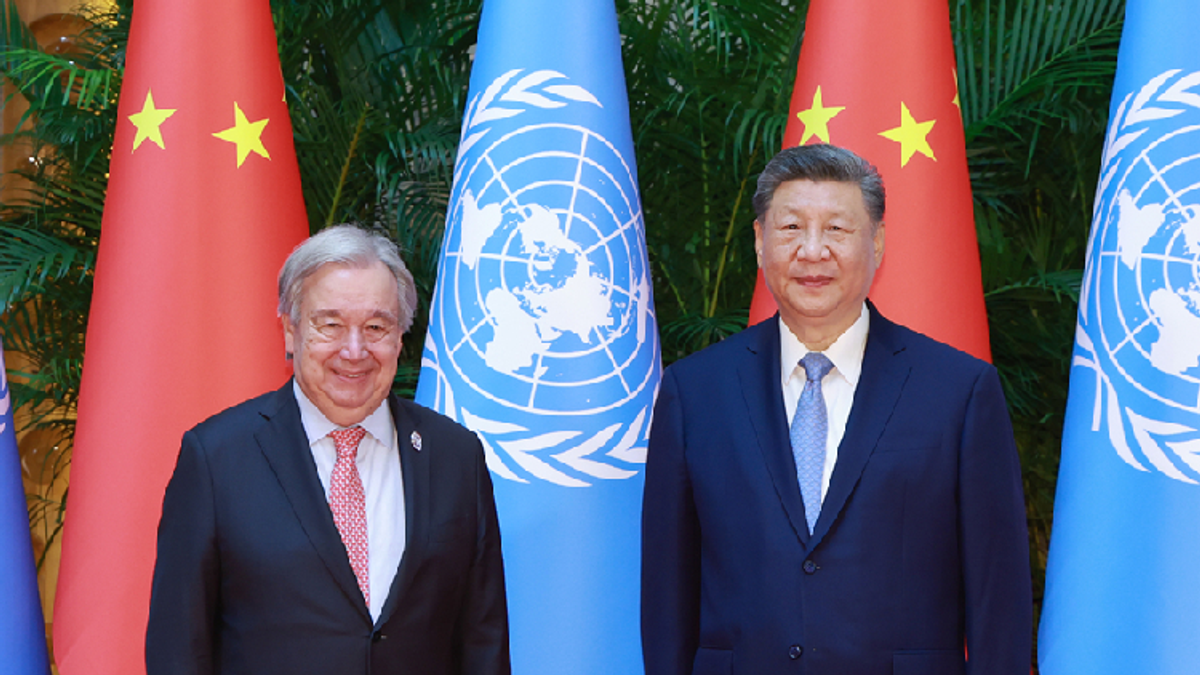
On July 17, 2026, Chinese President Xi Jinping met with United Nations Secretary-General Antonio Guterres in Shanghai, reaffirming China's steadfast support for the UN. The meeting, held on the sidelines of the 2026 World Artificial Intelligence Conference and High-Level Meeting on Global AI Governance, served as a significant platform for both leaders to articulate their visions for international cooperation amidst a period of pronounced global instability. President Xi's remarks underscored China's long-standing commitment to the UN, particularly as the nation marked the 55th anniversary of the restoration of the People's Republic of China's lawful seat at the organization.
President Xi lauded Secretary-General Guterres' decade-long tenure, commending his efforts in upholding multilateralism, addressing critical global challenges such as climate change, advancing governance in emerging fields like artificial intelligence, and spearheading UN reform. This praise aligns with China's consistent narrative of advocating for a multilateral world order, often presented as a counterpoint to perceived unilateral tendencies in international relations. Xi reiterated that China's proposed vision of building a "community with a shared future for humanity" and its four global initiatives are fundamentally aimed at upholding the UN's status and authority.
The timing and location of this high-level meeting offer crucial geopolitical insights. Shanghai, a hub for technological innovation, hosted a pivotal conference on AI governance, highlighting the growing importance of establishing international norms and regulations for this transformative technology. China, a leading nation in AI development, is strategically positioning itself to play a central role in shaping these global governance frameworks, thereby influencing future technological and economic landscapes. By hosting such a conference and engaging the UN Secretary-General, Beijing projects itself as a responsible major power committed to global problem-solving.
China's emphasis on "true multilateralism" and the revitalization of the UN's role comes at a time when the international system is indeed experiencing significant shifts and turbulence. This includes geopolitical rivalries, economic protectionism, and a fragmentation of global consensus on various issues. For Beijing, a strong UN, where China holds a permanent seat on the Security Council, serves as a crucial platform to promote a multipolar world order, balance the influence of Western-led alliances, and advance its own foreign policy objectives. The call for all countries to "uphold fairness and justice" and "assume their responsibilities" can be interpreted as an appeal for a more equitable distribution of global power and influence, consistent with China's vision of a reformed international system.
Secretary-General Guterres, in turn, praised China as a "firm supporter of multilateralism and the UN's endeavors," recognizing it as a "driving force for international cooperation." He specifically highlighted China's championship in addressing development imbalances, tackling climate change, developing AI for good, and upholding fairness and justice. Guterres' remarks underscore the UN's reliance on the engagement and support of major powers, particularly permanent members of the Security Council, to effectively address the myriad global challenges it faces.
Crucially, Guterres also stated that the UN would continue to strengthen cooperation with China to "resist unilateralism, protectionism, and domineering and bullying practices," while upholding the UN Charter and international law, and advancing world multipolarity. This statement, while not explicitly naming any nation, resonates with the broader international discourse surrounding challenges to the rules-based international order. It signals the UN's commitment to a system where international law and collective action prevail over individual state power, a principle that aligns with China's stated foreign policy goals.
The meeting between President Xi and Secretary-General Guterres reinforces the ongoing strategic dialogue between China and the UN, particularly concerning the future of global governance. China's proactive stance on issues like AI governance, climate change, and development initiatives demonstrates its ambition to be a key architect of the evolving international order. For the UN, securing the active participation and financial contributions of a major power like China is essential for its operational effectiveness and legitimacy. As the world grapples with complex, interconnected challenges, the collaboration between the UN and its most influential member states will be critical in determining the trajectory of global stability and cooperation. The emphasis on solidarity and shared responsibility, as articulated by both leaders, suggests a recognition that collective action is indispensable in navigating the turbulent international landscape of the mid-2020s.
Source referenced: CGTN
This brief was synthesized by our Editorial Engine and reviewed by The Ground Narrative team.