TRENDING

Tuesday, 6 October 2026
----------------------
25 Rabi' Al-Thani 1448 AH
China's recent declaration of a 'national nature reserve' at Scarborough Reef, disputed with the Philippines, is less about conservation and more about asserting control over vital maritime territory. This move, condemned by the US, directly impacts the livelihoods of Filipino fishermen caught in a high-stakes geopolitical struggle.
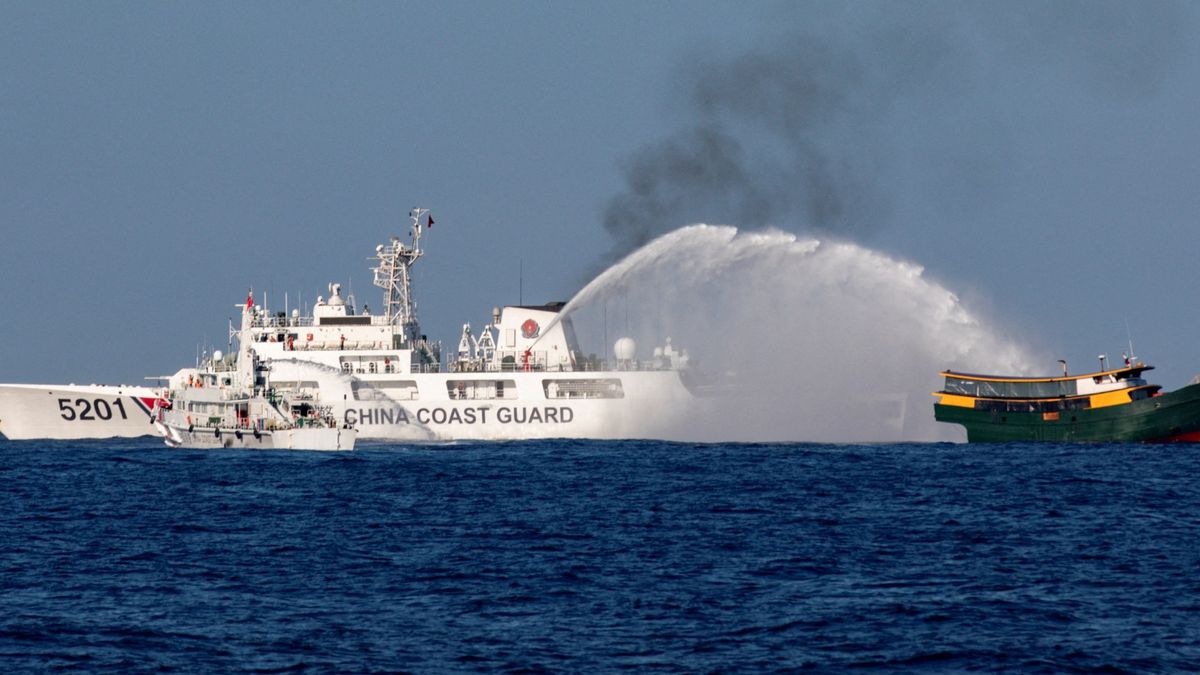
The United States has sharply criticized China's recent declaration of Scarborough Reef as a "national nature reserve," viewing it as a thinly veiled attempt to solidify its territorial claims in the South China Sea. This assertion, which effectively denies Filipino fishermen access to their traditional fishing grounds near the island of Luzon, comes amidst escalating tensions, including incidents where Chinese Coast Guard vessels have used water cannons against Philippine resupply and fishing boats. Washington has reiterated its rejection of China's broad "nine-dash line" claims and reaffirmed its alliance with the Philippines, underscoring the strategic importance of the contested waterway.
At its core, this dispute is a stark illustration of competing power dynamics in a critical global artery. For China, the declaration of a "nature reserve" serves as a clever legal and environmental pretext to advance its long-term ambition of establishing de facto control over the South China Sea. This strategy is multi-faceted: it aims to secure access to rich fishing grounds, potential hydrocarbon reserves, and, crucially, to project military and economic power across a maritime zone through which over $3 trillion in goods transit annually. By employing "grey zone" tactics – actions that fall short of overt military conflict but are highly coercive, like water cannon attacks and persistent coast guard presence – China seeks to alter the status quo without triggering a direct military confrontation, effectively sidestepping the 2016 Permanent Court of Arbitration ruling that largely dismissed its sweeping claims.
The United States, in turn, positions itself as a defender of international law and a "free and open Indo-Pacific." Its involvement is driven by a desire to maintain its regional influence, uphold freedom of navigation, and prevent any single power from dominating a waterway vital to global trade and its own strategic interests. By standing with its ally, the Philippines, and conducting joint military exercises with partners like Canada and Australia, the US aims to signal its commitment to regional security and deter further Chinese assertiveness, reinforcing its alliance network as a cornerstone of its Asia strategy.
The Philippines, a smaller nation with a legally recognized claim, finds itself in a precarious position. While it has international law on its side, the practical enforcement of that law against a powerful neighbor like China is a significant challenge. Its reliance on the US alliance provides a security umbrella, but also places it at the forefront of a great power rivalry, forcing difficult trade-offs between economic pragmatism and national sovereignty.
While governments and militaries engage in strategic maneuvers, the immediate and most profound impact is borne by the Filipino fishermen and their families. Scarborough Reef, known locally as Panatag Shoal, has been a traditional and abundant fishing ground for generations. China's effective blockade and harassment tactics mean these fishermen are losing their livelihoods, facing dwindling catches, and enduring constant threats to their safety. This isn't an abstract geopolitical game for them; it's a daily struggle for survival, impacting food security for their communities and stripping away a way of life passed down through generations. Beyond the immediate economic hardship, the constant tension and uncertainty in the region also affect broader economic stability, potentially deterring investment and disrupting supply chains that rely on the South China Sea's safe passage.
Both sides present their actions through carefully constructed narratives, often omitting or downplaying inconvenient truths. China's narrative frames its actions as a legitimate exercise of sovereignty and environmental protection. However, the irony of declaring a "nature reserve" while simultaneously engaging in extensive artificial island building—which has caused significant ecological damage—and deploying aggressive naval assets is stark. This environmental pretext conveniently ignores the international legal rulings and the direct economic harm inflicted upon neighboring communities. China's statements also consistently downplay the coercive nature of its "grey zone" tactics, presenting them as routine law enforcement.
The US narrative, while emphasizing adherence to international law and support for allies, often understates its own strategic interest in maintaining its dominant position in the Indo-Pacific. While freedom of navigation is a valid principle, the US also seeks to prevent a rival power from controlling a choke point that could impact its global military projection and economic interests. Furthermore, while the US offers diplomatic support and military assurances, it has yet to provide a concrete, actionable solution that directly addresses the immediate plight of the Filipino fishermen beyond rhetorical condemnations.
The situation at Scarborough Reef is a microcosm of the broader contest for influence in the South China Sea. Moving forward, observers should closely watch China's next steps: Will it further militarize its artificial islands? Will it escalate its "grey zone" tactics, perhaps by imposing an Air Defense Identification Zone (ADIZ) over contested areas, or implementing more stringent blockades? The Philippines' response will also be critical: How will Manila balance its security alliance with Washington against the constant economic pressure and the need to protect its citizens' livelihoods? Will it seek stronger international arbitration or explore multilateral diplomatic avenues? Finally, the US commitment will be tested: Beyond statements and joint exercises, what practical measures will it take to ensure freedom of navigation and protect its allies' economic interests? The reactions of other ASEAN nations will also be telling, as they navigate their own relationships with both Beijing and Washington, keenly aware that their own sovereignty and economic futures are intertwined with the evolving power dynamics in these contested waters. The fate of the reef, and the fishermen who depend on it, hangs in the balance.
Source referenced: ALJAZEERA
This brief was synthesized by our Editorial Engine and reviewed by The Ground Narrative team.