TRENDING

Monday, 5 October 2026
----------------------
24 Rabi' Al-Thani 1448 AH
Mass protests in Albania against Prime Minister Edi Rama's government highlight a complex interplay of domestic grievances, ambitious tourism development plans involving international investors like Jared Kushner, and the nation's EU accession aspirations. The 'flamingo revolution' underscores a critical debate over economic growth versus environmental protection and national sovereignty.
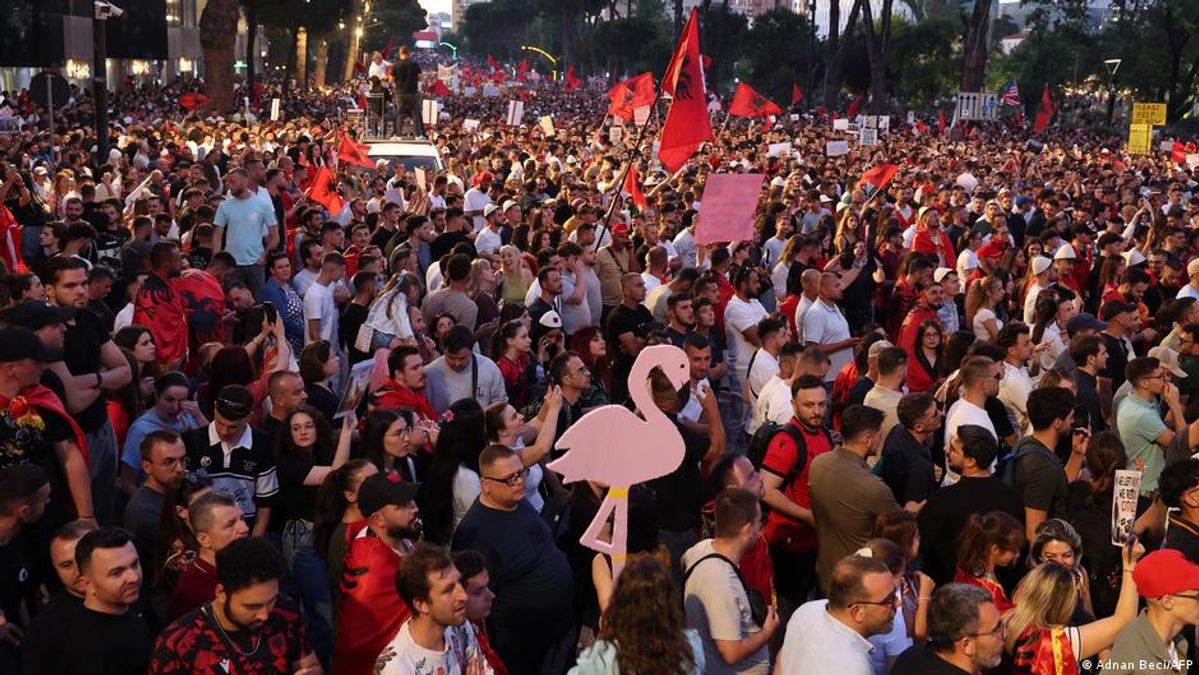
For over a month, Albania has been gripped by widespread protests, with thousands taking to the streets daily to demand the resignation of Prime Minister Edi Rama, who has been in power for nearly 13 years. These demonstrations, often dubbed the 'flamingo revolution,' signify a deepening crisis of public trust and a contentious debate over the country's development trajectory.
The protests, which began around May 2026, were initially sparked by public outrage over the planned construction of luxury resorts in the ecologically sensitive Vjose-Narta area, a vital habitat for rare species and migratory birds along the Adriatic coast. The discontent escalated when a previously public stretch of coastline was fenced off, fueling accusations that the government was prioritizing foreign investors over the interests of Albanian citizens. A central slogan, "Albania is not for sale!", encapsulates the public's fear of losing national assets.
Among the prominent investors in these projects is Jared Kushner, former US President Donald Trump's son-in-law, through his investment company, Affinity Partners. The proposed developments, projected to attract over €4 billion ($4.6 billion) in investment, include luxury resorts on the uninhabited island of Sazan and along the coastline. This significant foreign direct investment (FDI) is championed by Prime Minister Rama as essential for Albania's economic growth, particularly in the burgeoning tourism sector, which the World Travel and Tourism Council estimates could account for a quarter of the nation's GDP.
The feasibility of these large-scale projects was significantly bolstered by a February 2024 amendment to a local law on protected areas. This change now permits "strategic investments" and luxury hotels, along with necessary infrastructure, within nature reserves. While Prime Minister Rama, in an early June 2026 interview with DW in Bochum, Germany, asserted that these changes do not breach European standards, environmental activists and the European Commission have voiced strong criticism. The Commission, in its latest progress report on Albania, warned that this legal amendment has led to a deterioration of nature conservation, a critical concern given Albania's ongoing accession talks for EU membership.
Despite the sustained public pressure, Prime Minister Rama has remained largely unfazed, characterizing the protests as a "beautiful example of freedom, of democracy in action." He dismisses claims of a breakdown of trust and vehemently denies any privatization of public space. Crucially, Rama has introduced a geopolitical dimension to the domestic unrest, suggesting that much of the international criticism regarding environmental impacts is less about Albania itself and more about the involvement of US President Donald Trump's son-in-law. He posits that Albania has become a "stage for anti-Trump forces to voice their opinions," thereby framing the local protests within a broader international political narrative.
This situation highlights several strategic implications:
* US Economic Influence and Political Linkages: The involvement of a high-profile US investor with direct ties to a former (and potentially future) US President introduces a layer of geopolitical complexity. It raises questions about the nature of foreign investment, potential political leverage, and the perception of national sovereignty in a small, strategically located Balkan nation.
* EU Accession vs. Rapid Development: Albania's path to EU membership necessitates adherence to the bloc's environmental and governance standards. The current controversy places the government in a precarious position, balancing the pursuit of rapid economic development through FDI with the imperative to meet EU criteria and address domestic environmental concerns. The European Commission's warnings underscore the potential for these development choices to impede Albania's integration into the EU.
* Domestic Stability and Democratic Maturity: While Rama views the protests as a sign of democratic health, their scale and persistence indicate significant public discontent over governance, transparency, and the perceived prioritization of external interests. The ability of the Albanian government to manage these protests, address grievances, and maintain stability will be crucial for its domestic legitimacy and international standing.
* Regional Context: As a NATO member and an aspiring EU state, Albania's internal stability and governance practices have broader implications for regional security and the Western Balkans' integration into Euro-Atlantic structures. The debate over sustainable development and foreign investment resonates across the region, where similar pressures exist.
In conclusion, the protests in Albania are more than just a local environmental dispute; they represent a critical juncture for the nation, intertwining domestic political challenges with significant geopolitical and economic currents. The government's navigation of these complex demands—balancing economic ambition, environmental stewardship, public trust, and international political dynamics—will define Albania's trajectory in the coming years.
Source referenced: DW
This brief was synthesized by our Editorial Engine and reviewed by The Ground Narrative team.


