TRENDING

Sunday, 18 October 2026
----------------------
7 Jumada Al-Awwal 1448 AH
Mass protests in Tirana have erupted into violent clashes as students and citizens demand Prime Minister Edi Rama’s resignation over tuition hikes and corruption. The unrest reveals deep‑seated power struggles between the government, foreign investors, and a restless public.
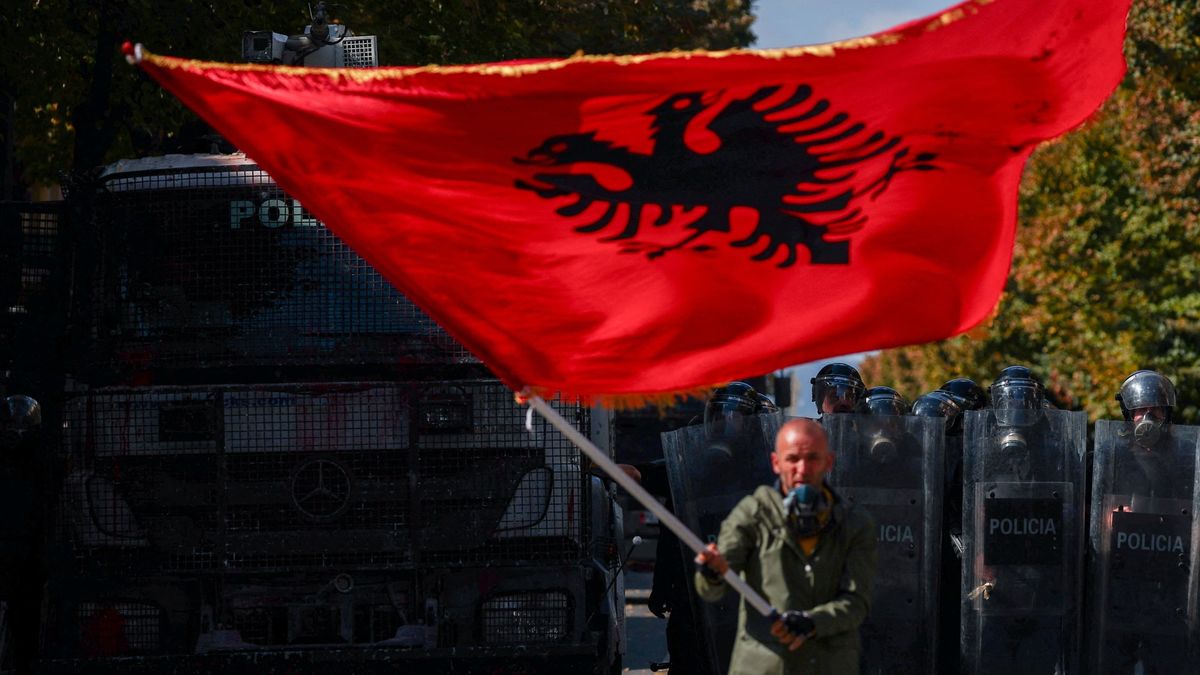
On 18 October 2026, riot police in Tirana faced thousands of demonstrators who threw Molotov cocktails, set trash bins ablaze and hurled tear‑gas canisters back at law‑enforcement. The flashpoint was a demand that Prime Minister Edi Rama step down, a call amplified by grievances over soaring university tuition, dilapidated campus facilities and accusations of graft tied to a controversial coastal resort project linked to the United States.
The protests, which began earlier in the month, have now turned into a sustained street battle. Photographs show a sea of Albanian flags, barricades of burning plastic, and police aiming firearms at crowds. Detentions are rising, and the government has responded with water‑cannon deployments and a curfew in the capital’s central districts.
The unrest cannot be reduced to a single issue; it is the convergence of several structural forces. First, Rama’s administration has pursued an aggressive foreign‑investment agenda, courting Western capital to modernise infrastructure while promising rapid economic growth. The resort development that sparked the first wave of protests is emblematic: a high‑profile project backed by a company tied to former President Donald Trump’s family, promising jobs but threatening coastal ecosystems and local land rights.
Second, the education sector has become a pressure valve. Tuition fees at public universities have risen by more than 40 % over the past three years, outpacing wage growth and inflating student debt. The government’s refusal to subsidise these costs, citing fiscal constraints, pits a youthful demographic against an entrenched political elite that relies on patronage networks.
Third, the security apparatus is being weaponised to preserve regime stability. The deployment of riot police equipped with crowd‑control weapons signals a shift from earlier, more permissive protest policies. This escalation is designed to deter further mobilisation, but it also risks delegitimising the state in the eyes of ordinary Albanians who see force as a sign of weakness.
Finally, regional geopolitics play a subtle role. Albania seeks NATO credibility and EU accession, both of which require a perception of internal stability. The government’s heavy‑handed response is therefore calibrated to reassure Western partners that it can maintain order, even as those same partners are criticised for turning a blind eye to the underlying socioeconomic grievances.
The most visible victims are university students and their families. Tuition hikes have forced many to take on part‑time work, compromising academic performance. Some have dropped out entirely, jeopardising a generation’s prospects and widening the country’s skills gap.
The protests have largely erupted in central Tirana, but the ripple effects hit low‑income districts where curfews restrict night‑time economic activity. Street vendors, informal transport operators and small shop owners report lost revenue as police checkpoints delay traffic and deter customers.
Molotov cocktails and tear‑gas exchanges have resulted in burns, respiratory issues and, in a few cases, serious injuries. Hospitals in the capital report a surge in emergency admissions, stretching already strained medical resources.
Hundreds of protesters have been detained, many without clear charges. Legal aid organisations warn that prolonged pre‑trial detention could become a tool for silencing dissent, eroding civil liberties and fostering a climate of fear.
Official statements from the Rama government frame the unrest as a fringe movement hijacked by “outside agitators” and “political opportunists.” What is omitted is the depth of public fatigue with a patronage system that concentrates wealth among a small elite while ordinary citizens see little improvement in public services.
International investors, particularly those linked to the Trump‑family resort, have downplayed environmental concerns and community displacement, portraying the project as a catalyst for tourism growth. Yet land‑use records reveal that local fishermen have lost access to traditional fishing zones, and the promised jobs have largely gone to foreign contractors.
Western diplomatic cables, obtained by investigative journalists, suggest that some EU officials are quietly urging the Albanian leadership to adopt a softer approach, fearing that a harsh crackdown could stall accession talks. This nuance is absent from public press releases, which instead highlight Albania’s commitment to law and order.
The next weeks will test whether the government can contain the unrest without further inflaming public anger. Key indicators include: the duration and scope of the curfew, any concessions on tuition policy, and the handling of detained protesters in the courts. Internationally, watch for statements from EU enlargement officials and NATO partners; a shift in tone could signal pressure on Rama to negotiate.
Equally important is the fate of the coastal resort project. If investors pull back or the government renegotiates terms, it could become a bargaining chip for protest leaders. Conversely, a swift approval could deepen resentment and fuel a broader anti‑establishment movement that may spill beyond the capital.
Finally, monitor the emergence of organized student unions or civic coalitions. Their ability to articulate clear demands and sustain peaceful pressure could redefine Albania’s political landscape, potentially reshaping the path toward EU accession and altering the balance of power between the state, foreign capital, and the Albanian populace.
The protests began over rising university tuition fees, poor campus conditions, and allegations of corruption tied to a US‑linked coastal resort development, leading demonstrators to demand Prime Minister Edi Rama’s resignation.
Authorities have deployed riot police, used water cannons and tear‑gas, imposed curfews in central Tirana, and detained hundreds of protesters, while framing the movement as driven by external agitators.
Editor's Note: Analysis based on publicly available reports and expert assessments; on‑the‑ground details may evolve.
Source referenced: ALJAZEERA
This brief was synthesized by our Editorial Engine and reviewed by The Ground Narrative team.