TRENDING

Sunday, 18 October 2026
----------------------
7 Jumada Al-Awwal 1448 AH
A mass funeral was held for 75 Palestinians whose remains were recently recovered from beneath the rubble of destroyed homes in Gaza City, nearly three years after the conflict began. These victims, mostly women and children, represent a fraction of the thousands still believed to be buried under the devastation.
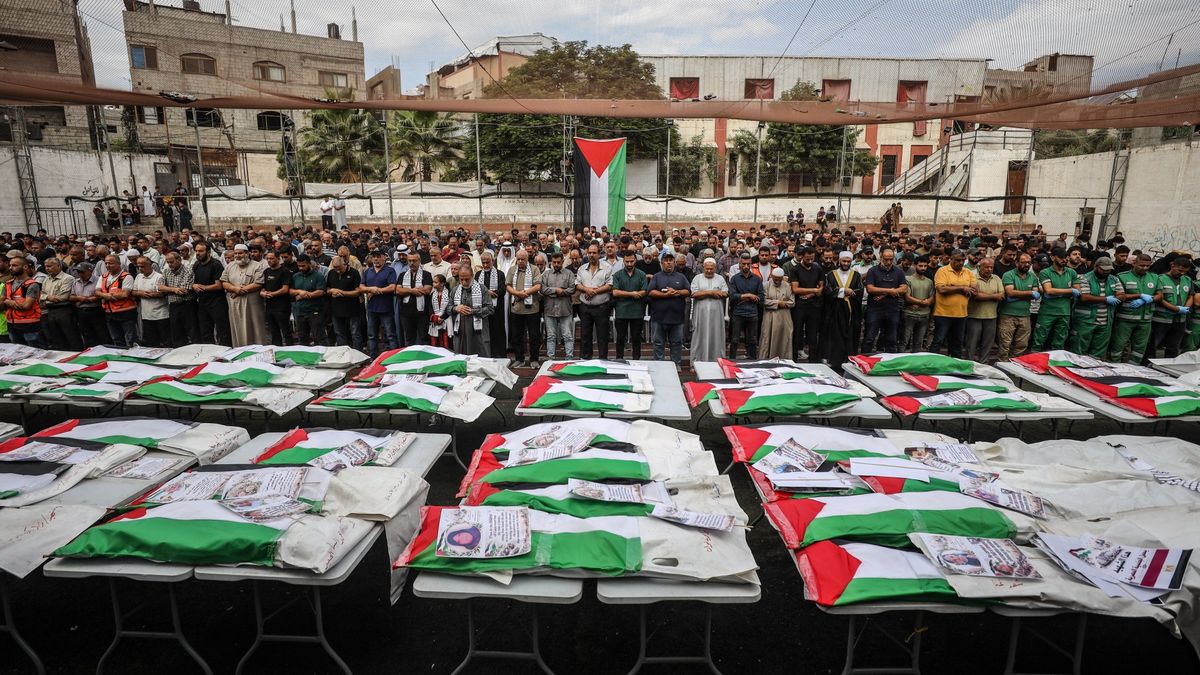
A solemn mass funeral recently took place in Gaza City for 75 Palestinians whose remains were recovered from beneath the debris of homes and buildings destroyed during the ongoing conflict. These victims, predominantly women and children from the Daraj neighborhood, had been buried under the rubble since the initial months following the war's onset in October 2023. The recovery efforts, undertaken by Gaza's Civil Defence amidst severe equipment shortages, underscore the enduring and hidden toll of the extensive destruction, with an estimated 8,000 more remains still believed to be trapped.
The protracted recovery of bodies in Gaza is not merely a logistical challenge; it is a stark manifestation of the power dynamics that govern the conflict and its aftermath. Israel's military operations, characterized by extensive aerial bombardment and ground incursions into densely populated urban areas, are framed as necessary to dismantle Hamas's capabilities. This doctrine, while effective in achieving military objectives, inevitably leads to widespread destruction and a high civilian death toll, a consequence often rationalized as unavoidable "collateral damage" in the pursuit of security. The very scale of this destruction, with UNRWA reporting 200,000 damaged or destroyed buildings, creates an environment where the full human cost remains obscured for years.
Hamas, for its part, operates within and among civilian populations, using a network of tunnels and infrastructure that further blurs the lines of combat. This strategy, while militarily advantageous for a non-state actor facing a superior conventional force, inherently places civilians at extreme risk and makes their protection a complex, often impossible, task. The international outcry over civilian casualties, while significant, is often insufficient to alter the fundamental military calculus of either side.
The international community's response, or lack thereof, further entrenches these dynamics. Major global powers, particularly the United States, maintain a steadfast alliance with Israel, providing diplomatic cover and military aid that limits the effectiveness of international pressure for accountability or immediate humanitarian intervention. Other states, while expressing concern, have largely failed to establish robust mechanisms for independent investigation into war conduct or to provide the massive resources needed for comprehensive recovery and reconstruction. The ongoing blockade of Gaza, enforced by Israel and Egypt, severely restricts the entry of heavy machinery, fuel, and materials essential for clearing rubble and rebuilding, thus perpetuating the crisis and making the grim task of finding the dead an agonizingly slow process. This deliberate constriction of resources, ostensibly for security reasons, inadvertently ensures that the physical scars of the conflict, and the human remains beneath them, persist as a constant reminder of the power imbalance.
The recovery of these 75 bodies, almost three years after their deaths, casts a long shadow over Gaza, revealing a human cost that extends far beyond immediate battlefield casualties. For the families of the deceased, this is not merely a statistic but a profound, delayed grief, a re-opening of wounds that never truly healed. The inability to properly bury loved ones for years denies families closure, trapping them in a perpetual state of mourning and uncertainty.
Imagine the psychological toll on parents, spouses, and children who have spent years not knowing the fate of their loved ones, holding onto a sliver of hope that is finally, brutally extinguished by the sight of fragmented remains. The process of identifying these bodies, often reduced to mere body parts or personal belongings, is an intensely traumatic experience, forcing families to confront the horrific reality of their loss long after the initial shock of the bombings. This delayed grief is a unique form of torture, preventing the normal processes of mourning and healing from ever truly beginning.
The fact that the majority of the recovered remains are women and children highlights the disproportionate impact of the conflict on the most vulnerable populations. Children who survive are left orphaned or witness unimaginable destruction, carrying deep psychological scars that will affect them for decades. The destruction of homes, schools, and infrastructure means that for those who remain, life is a constant struggle for basic necessities, compounded by the pervasive trauma. The very landscape of Gaza, littered with the rubble of 200,000 destroyed buildings, becomes a monument to loss, a daily reminder of a war that has consumed lives and futures. Moreover, the presence of thousands of decomposing bodies beneath the rubble poses significant public health risks, contaminating water sources and hindering any meaningful reconstruction efforts, further exacerbating the humanitarian crisis for the living.
What often goes unsaid or is deliberately downplayed by powerful actors is the systemic nature of this ongoing tragedy, and how narratives are constructed to obscure responsibility.
Governments and official statements, particularly from Israel and its key allies, frequently frame civilian casualties as an unfortunate but unavoidable consequence of fighting a terrorist organization embedded within a civilian population. This language of
The extensive destruction caused by military operations in densely populated areas left thousands of buildings as rubble. A severe lack of heavy machinery, fuel, and resources, exacerbated by the ongoing blockade, has made the recovery process agonizingly slow and difficult for local civil defense teams.
Reports indicate that the majority of the remains being recovered are those of women and children. These individuals were often inside their homes when buildings were targeted during the early months of the conflict, highlighting the disproportionate impact on civilian populations.
The unrecovered bodies contribute to a profound, delayed grief for families, denying them closure and exacerbating psychological trauma. Widespread destruction creates a public health crisis from decomposing remains and contaminated water, while hindering any meaningful reconstruction efforts, perpetuating a cycle of suffering for survivors.
Source referenced: ALJAZEERA
This brief was synthesized by our Editorial Engine and reviewed by The Ground Narrative team.