TRENDING

Monday, 19 October 2026
----------------------
8 Jumada Al-Awwal 1448 AH
On the 35th anniversary of the Tiananmen Square crackdown, prominent dissident Wu'er Kaixi critiques international engagement with China, asserting Beijing's profit-driven motives pose a global threat. His analysis challenges past diplomatic strategies and highlights ongoing human rights concerns, urging a re-evaluation of China's role in the world.
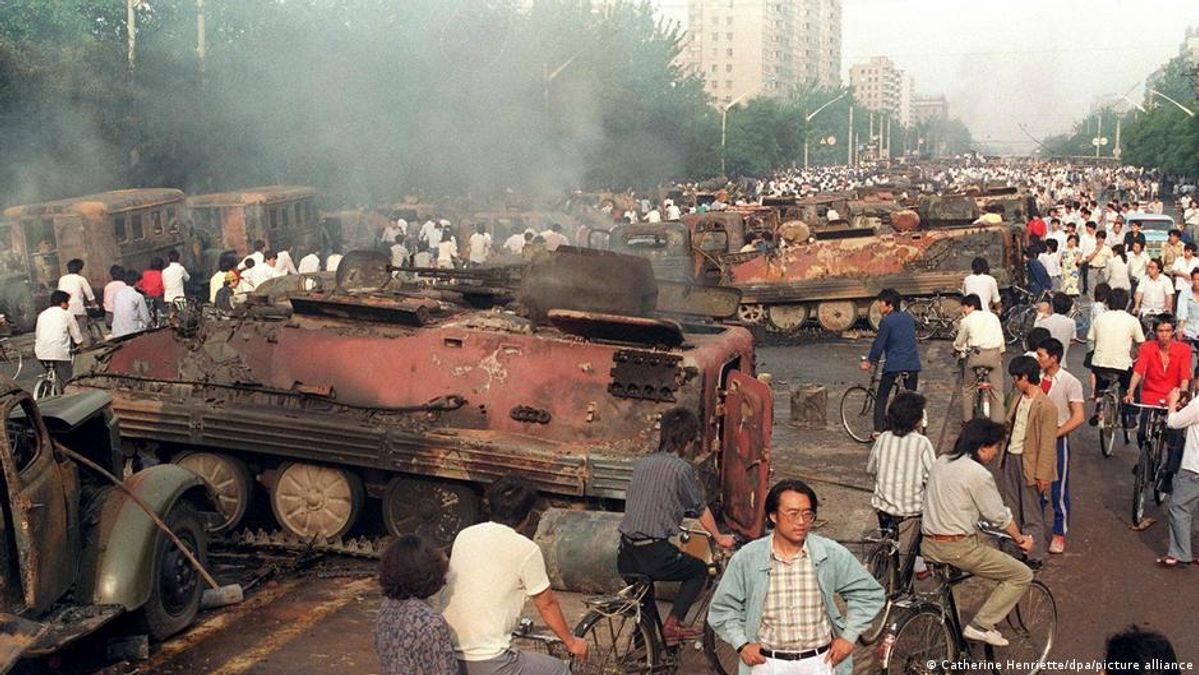
Thirty-five years after the brutal suppression of pro-democracy protests in and around Beijing's Tiananmen Square on June 4, 1989, the legacy of that pivotal event continues to shape China's domestic policies and its complex relationship with the international community. On this somber anniversary, Wu'er Kaixi, a prominent student leader from the 1989 movement, offered a stark assessment of China's trajectory and the global response to its rise, speaking from Tokyo. His remarks underscore a significant shift in how some international observers and policymakers are beginning to view Beijing's strategic intentions and the efficacy of past engagement policies.
Kaixi, now 58 and living in exile in Taipei, remains a vocal critic of the Chinese government, which has consistently denied him amnesty and the right to return home. His perspective is informed by decades of observing China's evolution from a state that crushed internal dissent to a global economic and political power. He contends that China represents "a direct threat to the entire civilization of mankind," not merely to internal dissenters or ethnic minorities like Tibetans and Uyghurs.
A central pillar of Kaixi's critique revolves around the perceived failure of the international community's long-standing strategy of engagement with China. For decades, many Western nations, led by the United States, pursued a policy predicated on the belief that economic liberalization and integration into global institutions, such as the World Trade Organization (WTO), would inevitably foster political reform and lead to a more democratic and responsible China. Kaixi argues this was a fundamental miscalculation, describing the US approach as "appeasement" that the rest of the world followed.
He posits that this strategy overlooked the true nature of the Chinese Communist Party (CCP), which he characterizes not as an ideologically driven or nationalist entity, but as a "criminal group that is driven by profit." This assertion challenges the conventional understanding of the CCP's motivations, suggesting that its actions, from internal repression to external assertiveness, are primarily aimed at enriching and empowering its leadership rather than serving a grand ideological vision or national rejuvenation. This perspective implies that economic incentives alone are insufficient to alter the CCP's authoritarian core.
However, Kaixi observes a growing international realization of this perceived mistake. He notes that countries like the United States, particularly under the Trump administration, have begun to approach China from a different, more confrontational perspective, utilizing economic leverage. Similarly, he suggests that Germany, a significant economic partner for China, is "waking up fast" to the challenges posed by Chinese firms' activities within its borders.
Kaixi's analysis extends to the geopolitical ramifications of China's economic power. He highlights examples such as China's state-owned Cosco Shipping Ports acquiring a nearly 25% stake in Hamburg's Tollerort container terminal, and the broader reach of Beijing's "Belt and Road" Initiative (BRI). These investments, while appearing as sound business propositions, are framed by Kaixi as mechanisms for enriching and empowering the Chinese leadership, potentially at the expense of the host nations' long-term strategic interests or sovereignty. This perspective aligns with growing concerns in Western capitals about the dual-use nature of Chinese infrastructure projects and investments, which can serve both commercial and strategic objectives.
Furthermore, Kaixi draws a direct line from China's internal repression and profit-driven motives to its external assertiveness. He warns that failure to resist Beijing's policies of political pressure and "territorial grabs from weaker neighbors" will only embolden the regime. This implicitly links the historical context of Tiananmen—the CCP's willingness to use force to maintain control—to contemporary issues such like China's claims in the South China Sea, its actions towards Hong Kong, and crucially, its ambitions regarding Taiwan. Kaixi, now a Taiwanese citizen and chairman of the Taiwan Association for Democracy in China, embodies this connection, serving as a living reminder of the CCP's historical actions and the ongoing struggle for democratic values in the region.
Beyond the geopolitical analysis, Kaixi's personal story underscores the profound human cost of dissent under an authoritarian regime. His decades in exile, unable to return home or see his parents, culminated in the painful news of his father's passing last year. This personal tragedy serves as a poignant reminder of the human rights abuses that continue to be a cornerstone of the CCP's governance, despite its economic modernization.
Kaixi's message on the 35th anniversary of Tiananmen Square is a call for the international community to adopt a more realistic and resolute stance towards China. His critique suggests that a purely economic or engagement-focused approach has not yielded the desired political liberalization and may have inadvertently strengthened an authoritarian power. The shift in international discourse, acknowledging China as a strategic competitor and a human rights challenge, indicates a potential reorientation of global policy. This re-evaluation will be critical in navigating the complex geopolitical landscape shaped by China's rising influence, balancing economic interests with democratic values and regional stability in the years to come.
Source referenced: DW
This brief was synthesized by our Editorial Engine and reviewed by The Ground Narrative team.