TRENDING

Tuesday, 6 October 2026
----------------------
25 Rabi' Al-Thani 1448 AH
Canada and the European Union are deepening their relationship, exploring new forms of partnership like 'associate membership,' driven by a shared need to diversify economic and security ties away from an unpredictable United States.
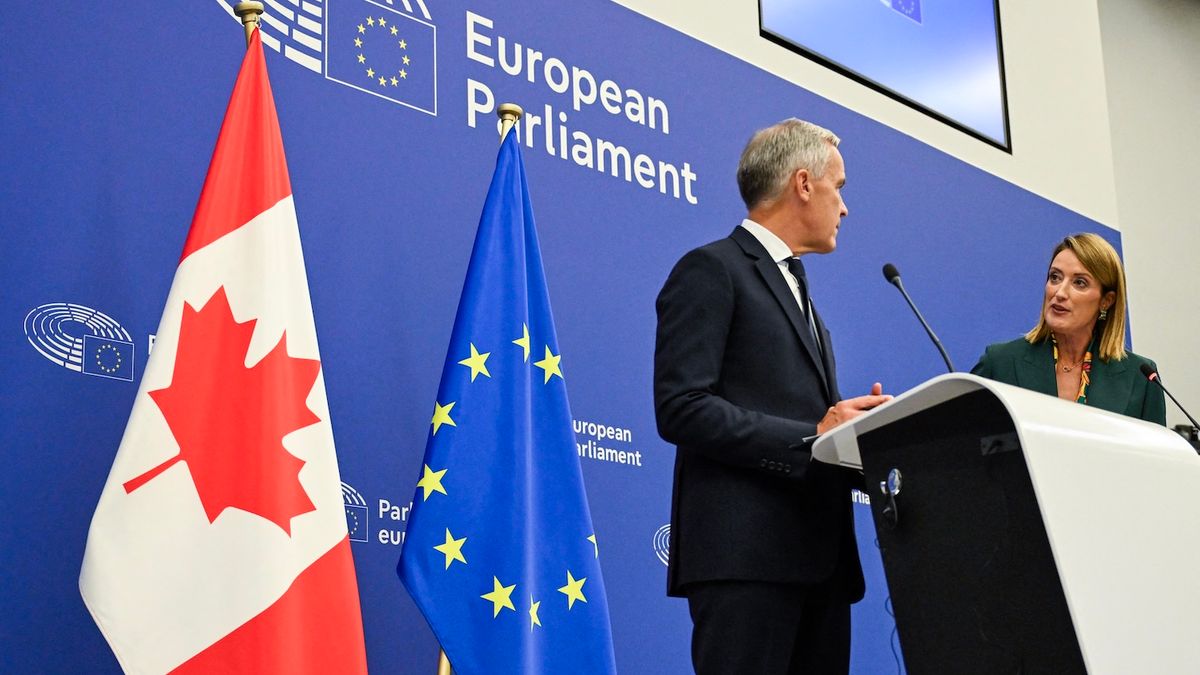
Canadian Prime Minister Mark Carney and European leaders, including European Parliament President Roberta Metsola and European Commission President Ursula von der Leyen, have been actively pursuing closer ties. Discussions have centered on expanding their partnership beyond the existing Comprehensive Economic and Trade Agreement (CETA) to include critical minerals, artificial intelligence, energy, space, and financial services. The concept of Canada becoming an 'associate member' of the EU has even been floated, signaling a significant shift in how both entities perceive their global alliances.
This deepening relationship is a direct response to a perceived instability in the global order, particularly the unpredictable nature of U.S. foreign policy, especially under a potential Donald Trump presidency. Both Ottawa and Brussels recognize the need to diversify their economic and security dependencies to gain greater leverage and resilience. For Canada, this means reducing its overwhelming reliance on the U.S. market, which currently dominates its trade relations. For the EU, it's about shoring up its standing in a volatile world, promoting trade liberalization, and securing critical resources and technological partnerships beyond its immediate neighborhood. The EU's exploration of 'flexible geometry' – nuanced ways to integrate non-members without full accession – is a key structural force, allowing it to build a ring of closely associated states (like Ukraine, Western Balkan nations, or even the UK) that share its values and contribute to its security and economic sphere, without the full obligations of membership. Canada's participation in the Security Action for Europe (SAFE) instrument further underscores this strategic realignment, as both seek to build alternatives to traditional security frameworks.
The human cost of these high-level strategic shifts often falls on specific populations. While trade diversification promises new opportunities, it can also lead to significant disruption for industries and workers accustomed to existing supply chains and market access. For instance, shifts in critical mineral sourcing or energy partnerships could impact mining communities in Canada or manufacturing hubs in Europe. Furthermore, the concept of 'associate membership' or other complex, non-full accession agreements raises questions of democratic accountability. Citizens in countries like Canada, or even those in aspirant EU nations, might find themselves subject to regulations and commitments made through opaque processes, without the full democratic representation or rights afforded to full EU members. This creates a potential democratic deficit, where decisions impacting daily lives are made in distant capitals with limited direct public input.
What is often downplayed by official statements is the sheer complexity and the inherent limitations of this 'lovefest.' While the rhetoric of 'associate membership' is compelling, the EU's founding treaties do not currently provide for such a status, meaning any such arrangement would require significant legal and bureaucratic innovation, or a reinterpretation of existing articles. This highlights the EU's institutional rigidity, which often struggles to match political ambition with legal reality. More critically, despite these diversification efforts, the United States remains the primary economic and security partner for both Canada and many EU member states. These new partnerships are a hedge, a means to gain leverage, rather than a fundamental pivot away from Washington. The true extent of U.S. influence, particularly in defense spending and intelligence sharing, is immense and cannot be easily replicated or replaced, meaning the powerful actors are subtly omitting the enduring, albeit sometimes uncomfortable, centrality of the U.S. in their strategic calculations.
Readers should closely watch the upcoming U.S. elections and the subsequent direction of American foreign policy. A shift towards isolationism would accelerate the Canada-EU alignment, while a more multilateral U.S. approach might temper its urgency. Domestically, observe how the EU attempts to formalize its 'flexible geometry' with other non-member states, as these precedents will directly influence any future arrangement with Canada. Progress on specific sectoral agreements – particularly in digital trade, critical minerals, and AI – will be a tangible measure of the partnership's depth. Finally, the full ratification of CETA by the remaining 10 EU member states will serve as a crucial litmus test for the political will to deepen economic integration, signaling whether this 'new math' is a long-term strategy or a temporary political maneuver.
Source referenced: FOREIGNPOLICY
This brief was synthesized by our Editorial Engine and reviewed by The Ground Narrative team.