TRENDING

Monday, 19 October 2026
----------------------
8 Jumada Al-Awwal 1448 AH
Chinese President Xi Jinping's upcoming visit to Pyongyang signals Beijing's intent to reassert influence over its sole treaty ally, North Korea, amidst Pyongyang's deepening ties with Russia. The high-stakes diplomatic engagement aims to manage regional stability, particularly concerning North Korea's nuclear ambitions, and navigate a complex geopolitical landscape involving the United States.
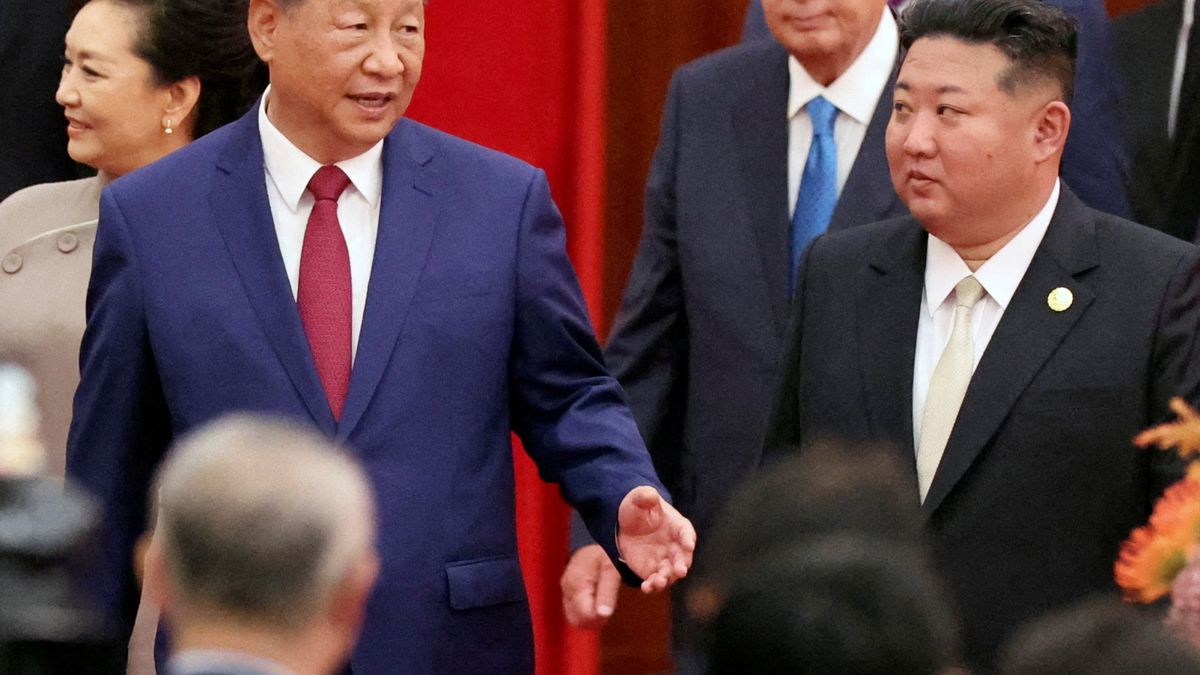
Chinese President Xi Jinping is set to embark on a significant two-day state visit to North Korea on June 8-9, following an invitation from North Korean leader Kim Jong Un. This visit, announced by state broadcaster CCTV, marks President Xi's first trip to Pyongyang in seven years, with his last engagement in 2019. The timing and context of this high-level meeting underscore Beijing's strategic imperative to re-engage with its only formal treaty ally, particularly as Pyongyang has visibly strengthened its diplomatic and military ties with Russia.
The visit comes on the heels of a series of crucial diplomatic engagements for President Xi, who recently hosted Russian President Vladimir Putin and, shortly before that, welcomed US President Donald Trump to Beijing. These interactions highlight China's intricate balancing act on the global stage, positioning the Pyongyang visit as a critical component of its broader foreign policy strategy to manage regional dynamics and global power shifts.
For Beijing, the primary motivation behind President Xi's visit is multifaceted. Historically, China has been North Korea's most significant political and economic patron, providing a vital lifeline to a nation under stringent international sanctions. According to 2022 statistics, North Korea relies on China for up to 95 percent of its total trade and 85 percent of its exports. This economic dependency grants Beijing considerable leverage, which it seeks to reinforce after the COVID-19 pandemic significantly curtailed bilateral exchanges.
However, the geopolitical landscape surrounding the Korean Peninsula has evolved. North Korea's deepening relationship with Russia, particularly since Moscow's invasion of Ukraine, has introduced a new dynamic. Pyongyang has reportedly supplied troops and weapons to support Russia's war efforts, a development that could potentially dilute China's traditional influence over its ally. Beijing's re-engagement aims to ensure that North Korea remains firmly within its strategic orbit, preventing an over-reliance on Moscow that could complicate regional stability and China's own security interests.
A significant point of concern for China is North Korea's rapidly advancing nuclear program. North Korean state media recently reported Kim Jong Un's call for an "exponential" expansion of the country's nuclear arsenal. Experts, such as Hong Min of the Korea Institute for National Unification (KINU), note Beijing's apprehension regarding North Korea's "extremely rapid" nuclear development. An unpredictable or overtly provocative North Korea, particularly one with an expanding nuclear capability, could trigger regional conflict, directly undermining China's interests in stability and economic development in Northeast Asia. China's Foreign Minister Wang Yi's visit to Pyongyang in April, where he called for enhanced coordination on international and regional issues, foreshadowed this strategic push for closer communication.
From Pyongyang's perspective, the visit offers an opportunity to solidify its indispensable economic and political support from China. Despite its burgeoning relationship with Russia, China remains the most crucial source of aid and trade for the diplomatically isolated nation. Kim Jong Un's invitation to Xi signals a desire to balance external relationships and secure continued backing from its most powerful neighbor.
North Korea's engagement with both China and Russia can be seen as a strategic maneuver to diversify its international support base and potentially gain greater leverage in negotiations with either power. While Russia offers military cooperation and a platform to circumvent sanctions, China provides the bulk of its economic sustenance and a critical diplomatic shield on the international stage. This delicate balancing act allows Pyongyang to pursue its nuclear ambitions while mitigating the full impact of international isolation.
President Xi's visit to Pyongyang is not merely a bilateral affair; it carries significant implications for the broader geopolitical landscape. It underscores China's determination to maintain its sphere of influence in Northeast Asia amidst increasing competition from other major powers. The visit will be closely watched by Washington, Seoul, and Tokyo, all of whom have a vested interest in the stability of the Korean Peninsula and the denuclearization of North Korea.
South Korea has historically expressed hope that Beijing can play a constructive role in promoting peace and stability in the region. However, China's primary interest lies in managing its own strategic environment, which includes a stable, albeit nuclear-armed, North Korea that does not destabilize the region or provoke a direct confrontation with the United States. The visit will likely focus on reaffirming the traditional alliance, coordinating on regional issues, and subtly signaling China's expectations regarding North Korea's nuclear program and its external engagements.
In essence, Xi's trip to Pyongyang is a critical diplomatic maneuver designed to recalibrate China's relationship with its long-standing ally, manage the complexities introduced by Russia's growing role, and safeguard China's strategic interests in a volatile region. It represents a concerted effort by Beijing to assert its leadership and maintain a delicate balance of power in a rapidly shifting global order.
Source referenced: ALJAZEERA
This brief was synthesized by our Editorial Engine and reviewed by The Ground Narrative team.