TRENDING

Friday, 16 October 2026
----------------------
5 Jumada Al-Awwal 1448 AH
China is strategically leveraging the shared cultural and religious worship of the sea goddess Mazu in Taiwan to advance its political narrative of unification. This soft power tactic aims to subtly integrate Taiwan by framing shared heritage as evidence of a 'one family' bond, despite resistance from many Taiwanese temples.
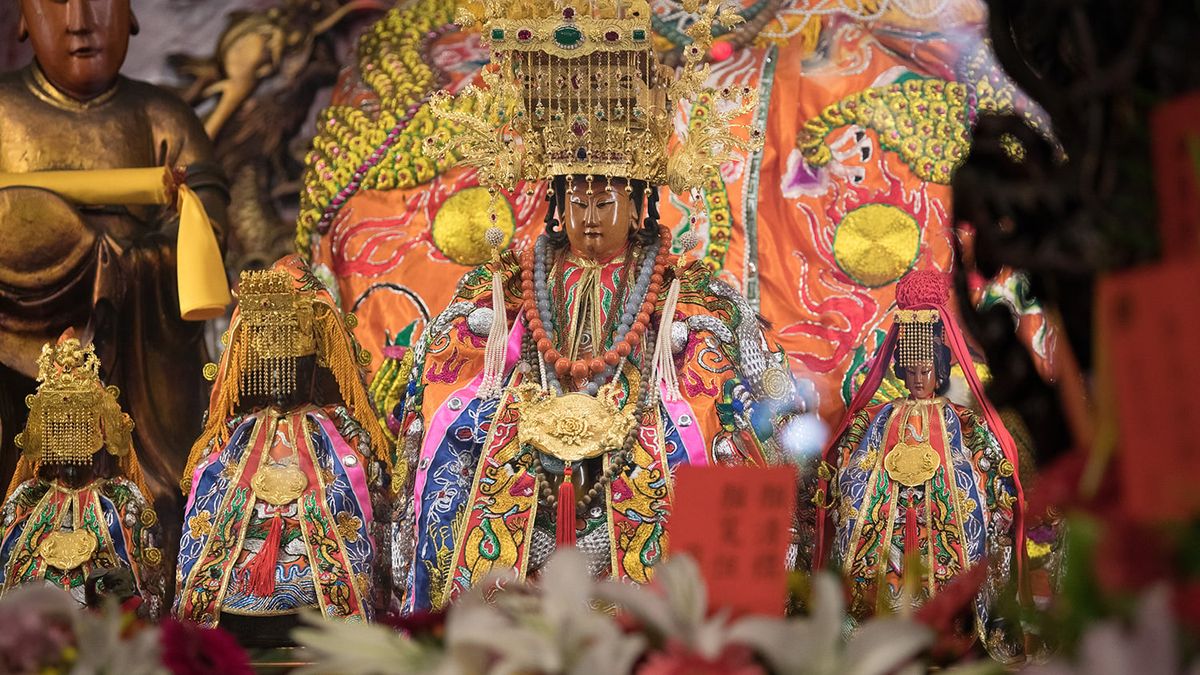
On a rain-soaked April day, tens of thousands of pilgrims traversed Taiwan's western coast, accompanying a palanquin bearing the revered sea goddess Mazu. This annual pilgrimage, a deeply ingrained cultural and religious event for over a million Taiwanese, has become a focal point in the complex geopolitical struggle between Beijing and Taipei. While Mazu worship represents a shared heritage across the Taiwan Strait, Beijing is increasingly leveraging this cultural connection to advance its political agenda of unification, framing the deity as a symbol of a "one family" narrative.
Mazu, also known as Matsu, is believed to have been a 10th-century woman from Fujian province in southern China, who later became the patron saint of sailors and fishermen. Her worship spread throughout coastal China and to Taiwan with Han Chinese migrants in the 17th century, who brought Mazu statues for protection during their perilous journey across the Taiwan Strait. These statues established ritual connections, known as *fenling* (division of spirit), linking Taiwanese temples to their ancestral origins in Fujian. Traditionally, *fenling* involves transferring spiritual energy from an older deity statue to a new one, creating a lineage that is periodically renewed through pilgrimages.
It is this deeply rooted shared heritage that Beijing is now strategically exploiting. The Chinese Communist Party (CCP) and state media are actively promoting Meizhou Island in Fujian, home to the Meizhou Mazu Temple, as the "original birthplace" and "ancestral temple" of Mazu worship. This narrative seeks to repurpose the religious concept of *fenling* into a political one, implying that all Mazu statues, and by extension their communities, ultimately belong to a single, China-centered origin point. Phrases like "all Mazus under heaven return home" are frequently invoked, subtly equating religious lineage with political allegiance.
The historical ties between Mazu temples in Taiwan and Fujian were significant through the Qing dynasty. However, these connections were severely curtailed under Japanese colonial rule in the late 19th century and completely banned when the Kuomintang (KMT) imposed martial law in Taiwan from 1949 to 1987, severely restricting travel across the strait.
Following the lifting of martial law in 1987, some Taiwanese temples, including the prominent Dajia Jenn Lann temple—which hosts the major Dajia pilgrimage and heads the Taiwan Mazu Fellowship—were among the first to resume exchanges with Fujian. This re-engagement has provided Beijing with an avenue to exert influence. Administrators of some Taiwanese Mazu temples, often wealthy businessmen with existing ties to China or political connections, facilitate these pilgrimage trips to Meizhou. For instance, the chairman of the Dajia Jenn Lann temple, Yen Ching-piao, is a former KMT legislator with a controversial past, highlighting the intersection of religion, business, and politics in these cross-strait exchanges.
However, the narrative of Meizhou's supreme authority is not universally accepted in Taiwan. Anthropologist Jacob Tischer notes that some Taiwanese temple proprietors believe the Meizhou temple lost its authentic status due to the destruction of its original buildings during China's Cultural Revolution (1966-1976), a period of intense anti-religious fervor. These temples contend that the "real center of gravity" and power of the Mazu cult now resides in Taiwan, leading many to refuse pilgrimages to Meizhou. This divergence underscores a broader resistance to Beijing's attempts to co-opt Taiwanese cultural identity.
Beijing's efforts to "turn Taiwan's sea goddess into a Chinese agent" represent a sophisticated soft power strategy aimed at undermining Taiwan's distinct identity and fostering a sense of shared destiny with mainland China. By leveraging a deeply personal and spiritual connection, China seeks to soften Taiwanese public opinion towards unification, presenting it as a natural return to an ancestral home rather than a political annexation. This approach is particularly potent because it taps into cultural and religious sentiments that transcend purely political arguments.
For Taiwan, the Mazu issue is emblematic of a broader struggle over national identity and sovereignty. While many Taiwanese acknowledge a shared cultural heritage with China, there is a strong and growing sense of a distinct Taiwanese identity. Beijing's attempts to instrumentalize Mazu worship are viewed by many as an infringement on religious freedom and an attempt to erase Taiwan's unique cultural and political trajectory. The varying responses from Taiwanese temples—some engaging with Meizhou, others asserting Taiwan's independent spiritual authority—reflect the complex and often divided sentiments within Taiwan regarding cross-strait relations.
This cultural front is a critical component of Beijing's multi-pronged strategy towards Taiwan, complementing military posturing, economic coercion, and diplomatic isolation. By attempting to reshape the cultural landscape, China aims to create internal divisions within Taiwan and erode international support for its democratic self-governance. The Mazu pilgrimages, therefore, are not merely religious processions; they are symbolic battlegrounds in the ongoing geopolitical contest for Taiwan's future, highlighting how cultural heritage can be repurposed as a tool of statecraft in the pursuit of strategic objectives.
Source referenced: FOREIGNPOLICY
This brief was synthesized by our Editorial Engine and reviewed by The Ground Narrative team.


