TRENDING

Friday, 16 October 2026
----------------------
5 Jumada Al-Awwal 1448 AH
A proposed luxury tourism development on Albania's protected Zvernec Peninsula, linked to Jared Kushner, has ignited widespread protests and drawn scrutiny from the European Union. The controversy highlights the delicate balance between economic development and environmental preservation, posing a critical test for Albania's aspirations to join the EU.
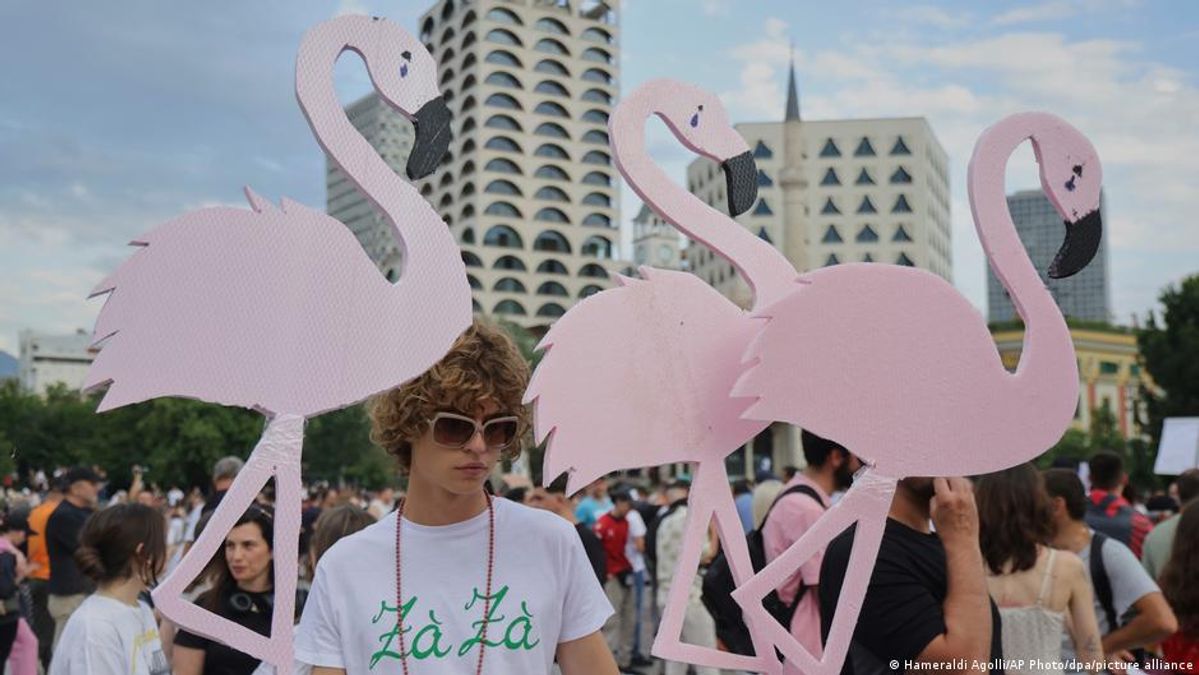
Albania finds itself at a critical juncture, balancing ambitious economic development goals with its commitment to environmental protection, a cornerstone of its European Union accession process. At the heart of this tension is the proposed Zvernec Peninsula development, a large-scale luxury tourism project linked to Jared Kushner, son-in-law of former US President Donald Trump. The project, slated for the ecologically sensitive Narta Lagoon area, has triggered significant public outcry and drawn the close attention of the European Commission, raising questions about Albania's adherence to EU environmental standards and governance principles.
The proposed development, located just 8 kilometers from the city of Vlora on Albania's southern coast, envisions a luxury tourism complex that developers claim could exceed €4 billion ($4.6 billion) in investment and create over 10,000 jobs. Albanian Prime Minister Edi Rama has championed the project as a "strategic investment" vital for elevating Albania into the "Champions League of global tourism," aiming to attract a high-end market. However, the chosen site, Pishe Poro–Narta, is a designated protected landscape of immense ecological value. It encompasses lagoons, wetlands, pine forests, and sand dunes, serving as a crucial habitat for hundreds of species, including protected pink flamingos, and a vital stopover for migratory birds traversing Europe and Africa.
On May 30, environmental activists attempting to access the construction site were met with private security and fences, leading to forceful removals captured in widely shared social media videos. This incident sparked a wave of solidarity protests in Tirana under the slogan "Albania is not for sale," with thousands demanding the project's halt and greater transparency regarding its approval process. Conservationists, like Besjana Shehu of the Albanian Ornithological Society, emphasize that the dispute transcends a local land issue, highlighting concerns over the ecological integrity of more than 18,000 hectares and the opaque decision-making surrounding such "strategic investments."
The timing and location of this project are particularly sensitive given Albania's ongoing EU accession talks. The Pishe Poro–Narta area has been proposed for the Emerald Network, an ecological network under the Bern Convention, and is expected to become part of the EU's Natura 2000 network upon Albania's membership. The European Commission views the management of such sites as a critical benchmark for Albania's capacity to preserve natural heritage as a future member state. As part of its negotiations on environment and climate change, Albania must demonstrate its ability to protect designated habitats and prevent ecosystem deterioration.
The European Commission has explicitly stated it is "closely following the developments" in Pishe Poro–Narta. It has reiterated concerns that the repeated extension of Albania's strategic investments law "continues to raise concerns about possible environmental impacts, particularly in protected areas," stressing that "EU standards must therefore be fully taken into account in this project." This stance underscores that environmental compliance is not merely a technicality but a fundamental requirement for EU membership, directly linking the fate of the Zvernec project to Albania's broader geopolitical aspirations.
Prime Minister Rama, while condemning the actions of private security, has firmly defended the project, arguing that conservation can coexist with economic activity in the area and that the project remains in a procedural phase without final environmental permits. However, the lack of transparency surrounding key decisions and the use of a "strategic investments law" that seemingly fast-tracks large projects raise significant governance concerns. These issues are critical for a country seeking to align with EU democratic and rule-of-law principles.
Beyond Albania's borders, the debate resonates across the Mediterranean. Ulrich Eichelmann, head of Riverwatch, highlights the Vjosa Delta, which includes parts of the project area, as the "last intact living delta in the entire Mediterranean." Its preservation is seen as a global fight against the widespread destruction of natural coastlines and river systems. The outcome of the Zvernec Peninsula dispute will not only shape Albania's economic and environmental future but also set a crucial precedent for sustainable development and environmental governance in a region grappling with similar pressures. The international community, therefore, watches closely as Albania navigates this complex intersection of national ambition, foreign investment, and European integration. The decision on this project will be a defining moment for Albania's path towards a European future, demonstrating its commitment to shared values and standards. Ultimately, it will reveal whether the pursuit of high-end tourism can genuinely align with the imperative of preserving irreplaceable natural heritage for future generations.
Source referenced: DW
This brief was synthesized by our Editorial Engine and reviewed by The Ground Narrative team.