TRENDING

Saturday, 24 October 2026
----------------------
13 Jumada Al-Awwal 1448 AH
Ukrainian President Zelenskyy's decision to name an army unit after the controversial WWII-era Ukrainian Insurgent Army (UPA) has sparked a severe diplomatic crisis with Poland. This move threatens to undermine the critical alliance between the two nations, providing a strategic advantage to Russia and complicating Ukraine's European integration aspirations.
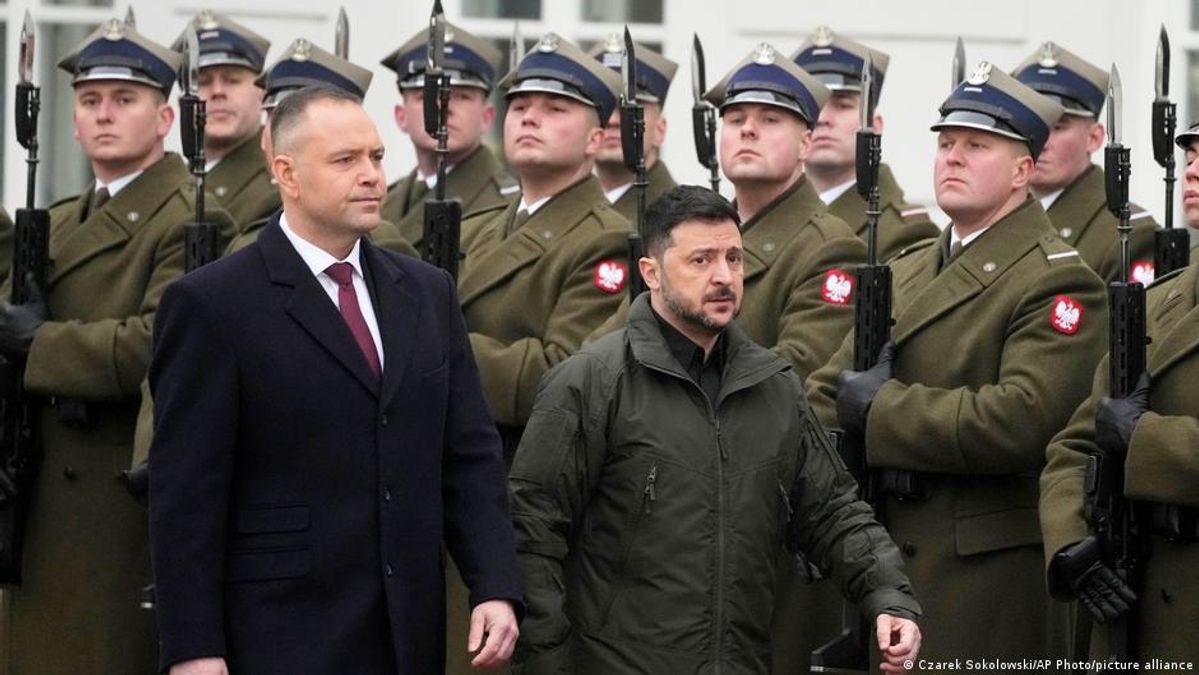
In a move that has ignited significant diplomatic tensions, Ukrainian President Volodymyr Zelenskyy issued a decree on May 26, 2026, bestowing the honorary name "Heroes of the UPA" upon a special forces unit of the Ukrainian army. Zelenskyy stated the decision was made "to restore the historical traditions of the national army." However, this action has provoked a sharp and critical response from Poland, a crucial ally for Ukraine in its ongoing conflict with Russia.
The Ukrainian Insurgent Army (UPA) was a nationalist paramilitary organization formed in 1941 following Nazi Germany's invasion of the Soviet Union. Its primary objective was to establish an independent Ukrainian state. While the UPA is revered in Ukraine as a symbol of resistance against both Soviet and, at times, Nazi occupation, its legacy in Poland is deeply controversial. The UPA is responsible for horrific war crimes against ethnic Polish civilians, most notably the massacres in Volhynia and eastern Galicia during World War II, which Poland refers to as genocide, claiming over 100,000 victims. These historical atrocities have long cast a shadow over Polish-Ukrainian relations.
The immediate and most forceful condemnation came from Poland's right-wing conservative President Karol Nawrocki. On May 29, 2026, Nawrocki declared that Zelenskyy had demonstrated Ukraine's unreadiness "to be part of the European family" by glorifying "bandits [who] murdered women and children, murdered Poles." He further announced his intention to initiate proceedings to strip Zelenskyy of the Order of the White Eagle, Poland's highest honor, which had been awarded to the Ukrainian leader in 2023 by former President Andrzej Duda. The award jury is scheduled to discuss the case on June 8, 2026.
Nawrocki's strong stance is not merely a reaction to historical grievances but also reflects a calculated domestic political strategy. Unlike his predecessor, Nawrocki has consistently voiced skepticism regarding Ukraine's European Union membership prospects and criticized the social support provided to Ukrainian refugees in Poland. Polish media, such as *Gazeta Wyborcza*, have suggested that Nawrocki is "ruthlessly exploiting" this pretext to inflame anti-Ukrainian sentiment and score points against his political rival, Prime Minister Donald Tusk. This internal political dynamic adds a layer of complexity to the bilateral dispute, as Nawrocki's actions are partly aimed at challenging Tusk's pro-European and pro-Ukrainian foreign policy.
Recognizing the severe implications of the escalating rhetoric, Polish Prime Minister Donald Tusk has sought to mitigate the damage. While acknowledging that Zelenskyy's decision violated Poland's "historical sensibility" and that "every nation... was entitled to its own interpretation of the past," Tusk urged "our Ukrainian friends" to show greater awareness of the "grim legacy of the UPA" from a Polish perspective. Crucially, Tusk distanced himself from Nawrocki's proposal to revoke Zelenskyy's order, warning that "if we quarrel about the past, someone else will win the future," explicitly stating that "the Kremlin will truly have reason to rejoice" if the dispute continues.
Other representatives of Poland's ruling center-left coalition have echoed Tusk's outrage but also called for de-escalation. Piotr Zgorzelski, the deputy marshal of the Polish parliament, suggested that Zelenskyy might be attempting to rally nationalist forces within Ukraine, inadvertently ignoring Polish sensitivities. The Ukrainian Foreign Ministry, in turn, issued assurances on May 29, 2026, that the new name was not aimed at Poland, asserting that for Ukrainian soldiers, the UPA's struggle "symbolizes exclusively opposition to Moscow's imperial policies."
The timing of this dispute is particularly delicate. Poland has been one of Ukraine's most steadfast and critical allies since Russia's full-scale invasion in February 2022, serving as a vital logistical hub for military aid, a sanctuary for over a million Ukrainian refugees, and a strong advocate for Ukraine's European integration. The initial enthusiasm for Ukraine's fight against aggression had largely overshadowed historical disagreements, but this recent development threatens to unravel that solidarity.
A significant rift between Warsaw and Kyiv would have profound geopolitical consequences. It would weaken the eastern flank of NATO and the European Union, providing a strategic advantage to Russia, which actively seeks to sow discord among its adversaries. Furthermore, Nawrocki's explicit linking of the UPA glorification to Ukraine's readiness for the "European family" could complicate Kyiv's aspirations for EU membership, a long-term strategic goal for Ukraine.
Prime Minister Tusk faces a significant dilemma: if he countersigns Nawrocki's decree to strip Zelenskyy of the Order of the White Eagle, he risks severely damaging the crucial relationship with Ukraine, upon whose success Poland's own security largely depends. If he refuses, he will be branded a traitor by the Polish right, further exacerbating domestic political tensions. The dispute also comes just weeks before the fifth Ukraine Recovery Conference, scheduled for June 25-26, 2026, in Gdansk, an international event crucial for Ukraine's reconstruction efforts. The current diplomatic row could overshadow the conference and potentially deter international support.
Ultimately, this episode underscores the enduring challenge of reconciling complex historical narratives with pressing contemporary geopolitical realities. For both Poland and Ukraine, navigating this sensitive terrain while maintaining a united front against a common aggressor is paramount for their respective national security and regional stability.
Source referenced: DW
This brief was synthesized by our Editorial Engine and reviewed by The Ground Narrative team.