TRENDING

Sunday, 25 October 2026
----------------------
14 Jumada Al-Awwal 1448 AH
An Israeli airstrike killed five Palestinians in Gaza as Egypt hosted new ceasefire talks, highlighting the fragile state of a U.S.-brokered truce. Disputes over Hamas's police force and Israeli withdrawal continue to impede a lasting resolution, exacerbating the humanitarian crisis.
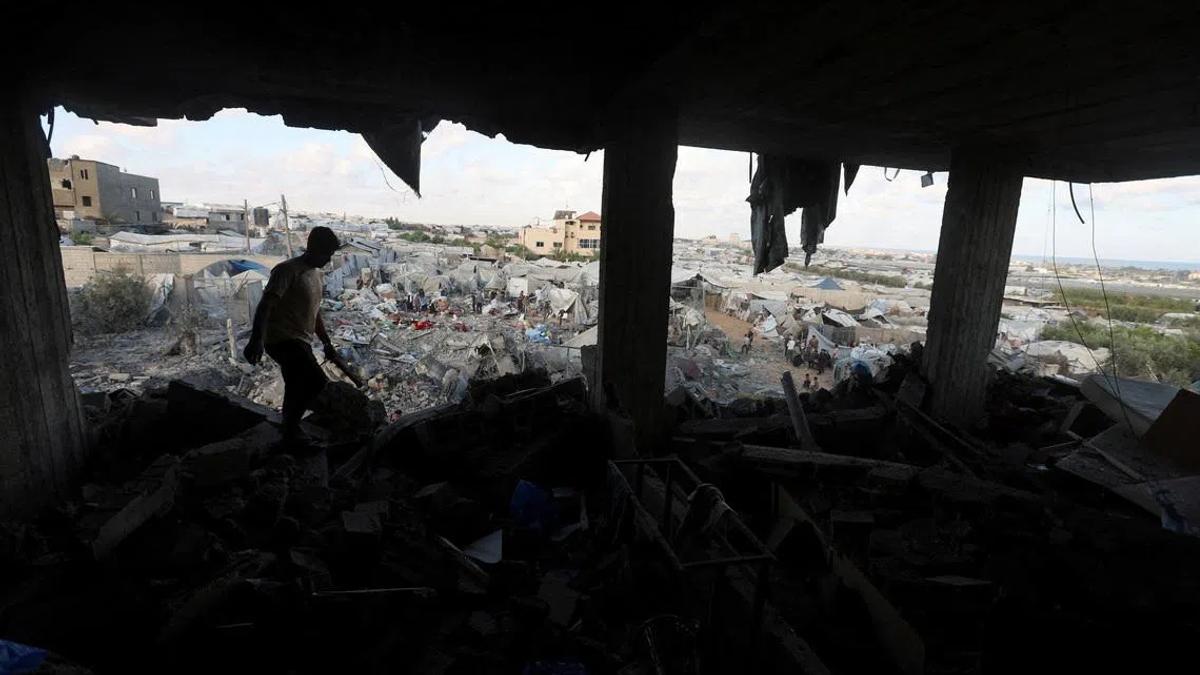
The Gaza Strip remains a focal point of intense geopolitical maneuvering and intermittent violence, even as international efforts strive to solidify a fragile ceasefire. On June 7, 2026, an Israeli airstrike on a Hamas-led police station in Khan Younis, southern Gaza, resulted in the deaths of five Palestinians and wounded at least 16 others, according to health officials. This incident occurred precisely as Egypt initiated a new round of ceasefire talks in Cairo, underscoring the precarious balance between military action and diplomatic engagement in the region.
The strike, which hit a police post adjacent to a large tent encampment housing displaced families, highlights Israel's continued strategy of targeting Hamas infrastructure and personnel. While the Israeli military did not immediately comment on this specific incident, Hamas security officials report that Israel has intensified its attacks against police headquarters and personnel over the past several months, leading to dozens of casualties. This pattern suggests a deliberate effort by Israel to degrade Hamas's administrative and security capabilities, even in the context of a broader ceasefire that has largely paused major fighting since October, following two years of prior conflict.
The current ceasefire, brokered by the United States and ratified by the United Nations Security Council, has been in effect since October. However, it has failed to transition into a comprehensive agreement for a lasting resolution. Key elements of a U.S.-backed plan, including the withdrawal of Israeli troops, the disarmament of Hamas, and the reconstruction of Gaza, remain unimplemented due to significant disagreements between the parties.
A central point of contention revolves around the future role of Hamas's nearly 10,000 police officers. Hamas insists on their inclusion in any new police force governing Gaza, viewing it as essential for maintaining order and asserting its continued influence. Conversely, Israel vehemently rejects any role for Hamas-affiliated personnel in a future Gaza administration, aligning with its stated objective of dismantling Hamas's military and governance structures. This fundamental disagreement over security control and political authority in Gaza forms a major impediment to advancing the U.S. President Donald Trump's plan for the territory, as referenced in the provided reporting.
Israeli troops currently control more than half of Gaza's territory, having ordered residents out and destroyed buildings, while nearly the entire population of 2 million now resides in a constricted coastal strip, often in makeshift tents or damaged structures under Hamas control. This demographic reality, coupled with the ongoing security vacuum and humanitarian crisis, complicates any proposed governance structure.
The new round of truce talks in Cairo, hosted by Egypt and involving leaders from Hamas and other Palestinian factions, represents a critical diplomatic push to salvage the stalled peace process. Egypt, alongside Qatar and Turkey, has been actively mediating between Israel and Hamas, attempting to bridge the significant divides. Hamas has communicated to these envoys and the U.S.-led "Board of Peace" that an end to Israeli attacks in Gaza is a prerequisite for any progress in the negotiations. Hazem Qassem, a Hamas spokesperson, expressed openness to ideas that would cease Israeli attacks and find common ground for the second phase of the Trump plan, but also accused the Board of Peace of being "biased" towards Israel.
The involvement of multiple international actors underscores the high geopolitical stakes. The U.S., through its "Board of Peace," aims to stabilize the region and implement a long-term resolution, but faces the challenge of navigating deep-seated mistrust and conflicting objectives. The continued accusations of truce violations—with Israel reporting four Israeli soldiers killed by Palestinian militant attacks since the truce, and Gaza health authorities reporting over 950 Palestinian deaths from Israeli strikes—further illustrate the fragility of the current arrangement and the difficulty in establishing mutual confidence.
The broader context of the conflict is dire. Since the war began following the October 7, 2023, Hamas-led attacks that killed 1,200 people and took 251 hostages, Gaza health authorities report nearly 73,000 people killed, most of them civilians. This catastrophic human toll, combined with the displacement of almost the entire population and the destruction of infrastructure, creates an urgent humanitarian crisis that demands a political resolution.
The ongoing talks in Cairo are therefore not merely about a ceasefire but about the fundamental future of Gaza and its governance. The inability to resolve core issues like Hamas's disarmament, Israeli withdrawal, and the composition of a new Gaza government risks perpetuating a cycle of violence and instability. The international community's ability to facilitate a durable peace will depend on its capacity to address these complex security, political, and humanitarian dimensions, while navigating the deep-seated animosities and strategic imperatives of all parties involved. The outcome of these negotiations will have profound implications not only for the immediate future of Gaza but for regional stability and the broader dynamics of the Israeli-Palestinian conflict.
Editor's Note: The source article refers to 'U.S. President Donald Trump's plan for Gaza' and a 'Board of Peace led by Trump' in the context of events in June 2026. This information is presented as stated in the raw article, without alteration.
Source referenced: STRAITSTIMES
This brief was synthesized by our Editorial Engine and reviewed by The Ground Narrative team.