TRENDING

Wednesday, 4 November 2026
----------------------
24 Jumada Al-Awwal 1448 AH
A recent meeting between Chinese and Thai foreign ministers signals Beijing's deepening influence in Southeast Asia. This engagement highlights Thailand's critical role in China's regional ambitions, particularly concerning the Mekong River and infrastructure development.
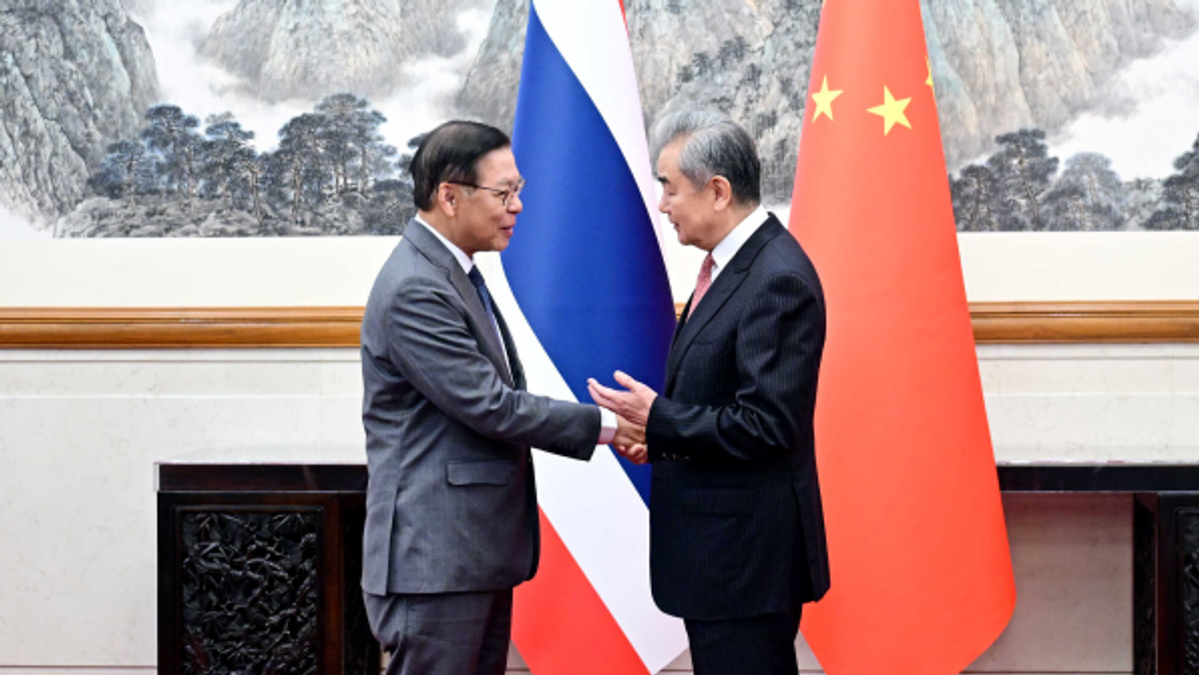
On November 3, 2026, Chinese Foreign Minister Wang Yi met with Thai Deputy Prime Minister and Foreign Minister Sihasak Phuangketkeow in Beijing. The high-level meeting underscored a mutual desire for stronger strategic communication and deeper cooperation, with Wang Yi emphasizing the principle that "China and Thailand are one family." The Chinese minister specifically praised the new Thai government, led by Prime Minister Anutin Charnvirakul, for its commitment to a friendly policy towards China, asserting that such a stance serves Thailand's fundamental interests and contributes to regional stability. In response, Sihasak congratulated China on its recent political milestones and lauded Beijing's contributions to the development of the Lancang-Mekong region, signaling Thailand's willingness to advance their comprehensive strategic cooperative partnership.
This seemingly cordial diplomatic exchange is a clear demonstration of Beijing's enduring strategy to solidify its influence in Southeast Asia, with Thailand serving as a pivotal node. For China, the deepening ties are less about familial bonds and more about securing vital economic corridors, enhancing regional security, and projecting its vision for a new global order. Thailand's geographic position, bridging mainland Southeast Asia with the Indian Ocean, makes it indispensable to China's Belt and Road Initiative (BRI). Key projects, such as the China-Thailand high-speed rail, are not merely infrastructure investments; they are arteries designed to integrate regional economies more closely with China's industrial heartland, facilitating trade, resource flows, and the movement of people under Beijing's economic orbit.
From China's perspective, a friendly Thailand is crucial for several reasons. Economically, Thailand is a significant trading partner and a major destination for Chinese tourism and investment. Politically, securing Thailand's alignment helps to dilute the influence of traditional Western powers, particularly the United States, in a region historically contested by external actors. The emphasis on the Lancang-Mekong region is particularly telling. China, as the upstream power controlling the headwaters of the Mekong River (known as the Lancang in China), wields immense leverage over downstream nations. Its extensive damming projects offer both opportunities for power generation and control over water resources, a critical strategic asset in a climate-vulnerable region. By framing its involvement as a
The 'community with a shared future' is a concept in Chinese foreign policy promoting closer ties and shared interests with partner nations. For Thailand, it implies aligning its long-term development and strategic goals more closely with Beijing's vision for regional and global governance, often with China at the center.
China's extensive damming of the upstream Lancang River (Mekong) significantly alters water flow, sediment, and ecological balance downstream. This impacts fishing, agriculture, and livelihoods for millions in Thailand and other Mekong nations, leading to concerns about food security and environmental degradation.
Economic benefits include significant Chinese investment in infrastructure, increased trade, and tourism, boosting Thailand's economy. Risks involve potential debt from large-scale projects, over-reliance on a single economic partner, and environmental costs from resource management that may impact local communities and long-term sustainability.
Editor's Note: The analysis focuses on the strategic implications of the meeting, drawing on historical context of China's regional ambitions and Thailand's balancing act, especially concerning the Mekong River and infrastructure projects. The 'community with a shared future' concept is interpreted through a power lens.
Source referenced: CGTN
This brief was synthesized by our Editorial Engine and reviewed by The Ground Narrative team.