TRENDING

Monday, 5 October 2026
----------------------
24 Rabi' Al-Thani 1448 AH
ExxonMobil chief executive Darren Woods has warned that Venezuela remains too risky for major investment without sweeping legal and commercial reforms, pushing back against US President Donald Trump’s call for oil companies to pour billions into reviving the country’s energy sector.
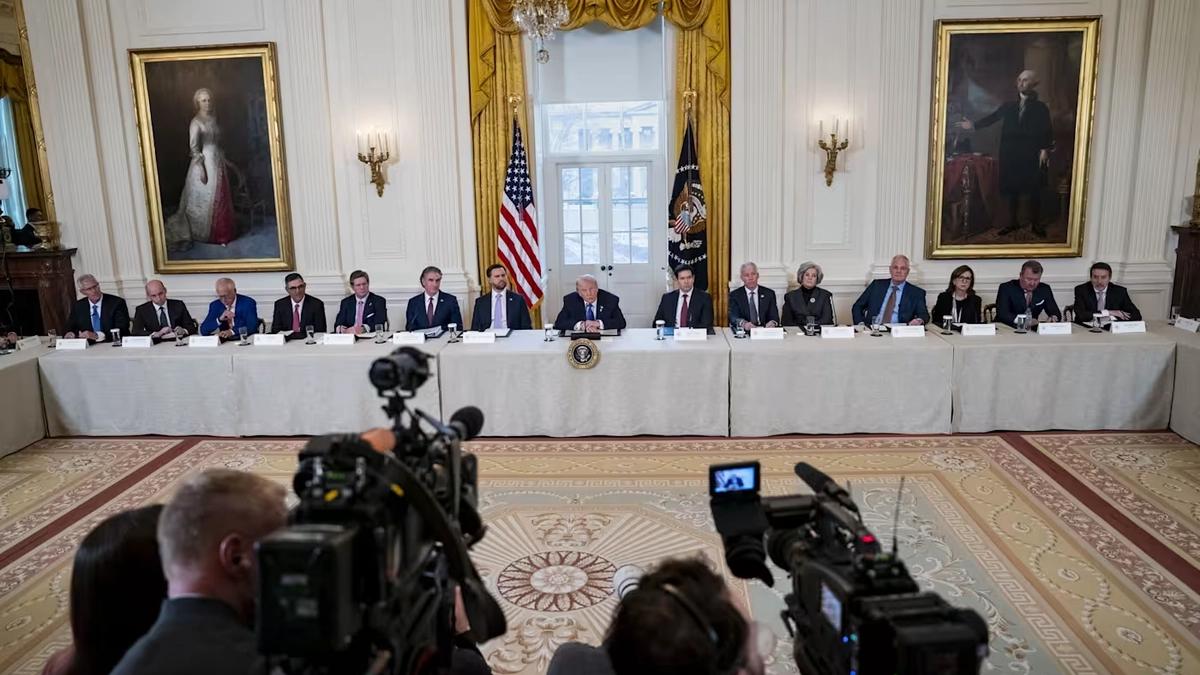
Major US oil companies remain deeply cautious about investing in Venezuela, despite intense pressure from President Donald Trump to inject billions of dollars into reviving the country’s shattered oil industry, citing persistent legal, political and security risks.
At a high-profile White House meeting with energy executives on Friday, ExxonMobil chief executive Darren Woods delivered a blunt assessment: Venezuela is still “uninvestable” without sweeping structural reforms. His remarks highlighted the sharp divide between the administration’s ambitions and the oil industry’s risk calculations.
Woods told Trump that Venezuela’s current legal and commercial frameworks offer no durable protection for investors.
“Significant changes have to be made,” he said, pointing to weak rule of law, unstable hydrocarbon regulations and the absence of long-term investment guarantees. Woods also reminded the audience that ExxonMobil’s assets in Venezuela had been seized twice since the company first entered the country in the 1940s.
His intervention underscored why many multinational energy firms remain reluctant to make large capital commitments, even as the US seeks to tap the world’s largest proven oil reserves to boost supply and curb domestic fuel prices.
The meeting followed Trump’s dramatic operation in Caracas last week that resulted in the capture of Venezuelan leader Nicolás Maduro and Washington’s attempt to assert control over the country’s vast natural resources.
Trump urged executives to move quickly, warning that companies unwilling to invest could be sidelined. “If you don’t want to go in, just let me know,” he said, adding that dozens of other firms were ready to take their place.
The president insisted that oil companies—not US taxpayers—would fund the effort, estimating investments of at least $100bn. He also dismissed the possibility of compensating firms for past expropriations, telling executives to treat Venezuela as a “clean slate”.
While ExxonMobil remained cautious, several companies with existing Venezuelan exposure expressed guarded optimism.
However, even executives who welcomed the opportunity stressed that regulatory clarity and sanctions relief were essential.
Trump sought to reassure companies by promising “total safety” for operations, suggesting that local Venezuelan authorities—rather than US troops—would provide on-the-ground security. The assurance did little to allay broader concerns.
Legal and geopolitical experts warned that instability remains the central obstacle.
“The legal, political and geopolitical risks are very significant,” said Meghan O’Sullivan, a Harvard professor specialising in energy geopolitics. Others noted that unclear licensing rules and sanctions enforcement continue to deter concrete investment decisions.
Despite growing interest and exploratory discussions, analysts say most companies are still far from committing capital.
“It’s one thing to call an adviser,” said Aurelio Fernandez-Concheso of Clyde & Co in Caracas. “It’s another thing entirely to write a cheque.”
As Trump pushes ahead with his Venezuela strategy, the response from oil executives suggests that enthusiasm remains conditional—and that without deep legal reform and credible guarantees, Venezuela’s oil revival may remain more political ambition than commercial reality.