TRENDING

Monday, 19 October 2026
----------------------
8 Jumada Al-Awwal 1448 AH
A crowd of students and activists forced Israel’s far‑right security minister off a university stage, exposing deep fissures in Israeli society. The incident reveals how political survival, institutional authority, and everyday lives intersect on a contested campus.
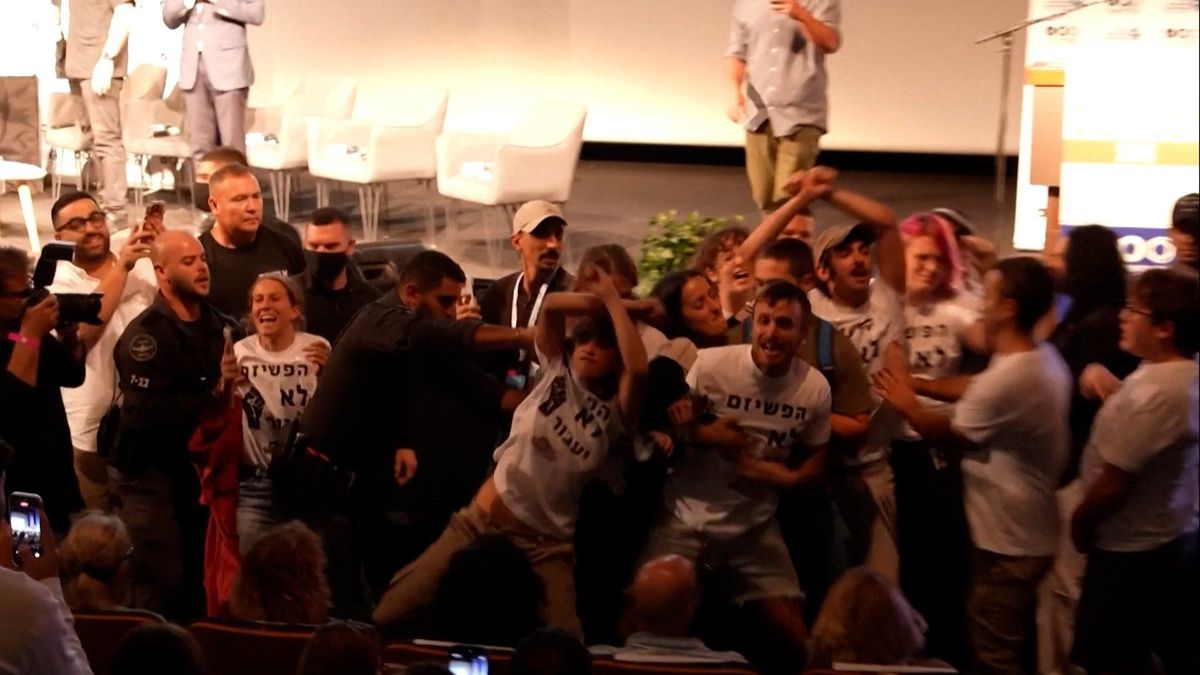
On 18 October 2026, a scheduled talk by Itamar Ben‑Gvir, Israel’s National Security Minister, at Tel Aviv University was abruptly halted. Demonstrators, chanting “There will be no fascism here,” formed a sit‑in, clashed with security personnel, and ultimately escorted the minister off the stage. The event, intended to showcase the government’s hard‑line stance on security, turned into a flashpoint of dissent, with video footage spreading across social platforms within minutes.
The protest began shortly after the minister took the podium. A small group of students raised signs denouncing the “far‑right agenda,” and within minutes the crowd swelled as faculty members and alumni joined. Security forces, deployed by the university and the Ministry of Public Security, attempted to clear the area, but the demonstrators formed a human chain, preventing the minister’s exit. After a tense standoff lasting roughly fifteen minutes, police used a non‑lethal crowd‑control method and escorted Ben‑Gvir out under a police escort. No injuries were reported, but the incident sparked a wave of commentary in Israeli media and abroad.
The clash is not merely a campus dispute; it sits at the intersection of several structural forces shaping Israeli politics. First, the Israeli government has, since the 2023 elections, leaned heavily on a coalition that includes ultra‑nationalist parties. Ben‑Gvir, a leading figure of that bloc, wields disproportionate influence over security policy, using his ministerial platform to push legislation that expands police powers and restricts Palestinian civil liberties. His public appearances serve both as policy signaling and as a rallying point for the coalition’s base.
Second, the university environment functions as a micro‑cosm of societal contestation. Tel Aviv University, historically a hub for left‑leaning intellectuals, has seen increasing pressure from the Ministry of Education to curb “politically motivated” events. The administration’s decision to host Ben‑Gvir was likely motivated by a desire to avoid punitive funding cuts, illustrating how fiscal levers can shape academic freedom.
Third, the student movement taps into a broader generational backlash against what many perceive as the erosion of democratic norms. Recent years have seen a surge in campus‑based activism across Europe and the United States, and Israel is no exception. The protesters’ slogans echo a growing narrative that frames the far‑right coalition as an existential threat to civil liberties, especially in the context of ongoing settlement expansion and the legal status of Palestinians.
Finally, the security apparatus itself is caught between two imperatives: maintaining order and preserving the image of a democratic state. Deploying police at a university event signals a willingness to enforce the coalition’s agenda, yet the visible resistance forces the state to confront the optics of heavy‑handedness. This tension fuels a feedback loop where each side escalates its tactics to protect its legitimacy.
While political analysts dissect power plays, ordinary people bear the brunt of the fallout. For Palestinian communities in the West Bank and Gaza, the protest underscores a trajectory of policies that further marginalize them—expanded policing powers, stricter permit regimes, and heightened surveillance. The rhetoric emanating from the minister’s office often translates into on‑the‑ground restrictions that limit movement, employment, and access to services.
Within Israel, students and faculty face an increasingly fraught academic climate. The threat of funding cuts or disciplinary action for hosting controversial speakers creates a chilling effect, limiting open debate and stifling research. Moreover, the presence of armed security forces on campus can heighten anxiety, especially among minority students who may feel targeted by broader state policies.
The security personnel themselves are placed in a precarious position. They are tasked with enforcing orders that may conflict with personal convictions, leading to morale issues and potential attrition. The incident also raises concerns about the mental health impact on officers who must navigate violent confrontations in environments traditionally considered safe spaces.
Economically, the disruption has indirect costs. Universities rely on international partnerships and student exchanges; a reputation for suppressing dissent can deter foreign scholars and funding bodies, ultimately affecting the quality of education and research output.
Official statements from the Israeli Ministry of Public Security framed the incident as an isolated act of lawlessness, emphasizing the need for “order and respect for democratic institutions.” What is omitted, however, is the systematic pattern of legislative changes that have expanded police authority over public assemblies, especially those critical of the government. By focusing on the immediate disruption, officials sidestep a deeper discussion about the legal environment that enables such confrontations.
Media coverage, both domestic and international, often highlights the spectacle—videos of chanting crowds and police shields—while downplaying the underlying grievances. The narrative of “students disrupting a minister” simplifies a complex debate about the balance between security and civil liberties, allowing the government to portray dissenters as fringe agitators rather than participants in a legitimate democratic discourse.
Another layer lies in the foreign diplomatic community. Several European embassies issued muted statements expressing concern over “freedom of expression,” but stopped short of criticizing Israel’s internal security policies. This diplomatic restraint reflects a broader geopolitical calculus: many Western capitals balance criticism of Israel’s domestic policies against strategic alliances in the Middle East, especially amid rising regional tensions.
Lastly, the legal ramifications are being quietly negotiated behind closed doors. The university’s legal counsel is reportedly consulting with the Ministry of Education about potential sanctions for hosting a minister whose policies are deemed “incompatible with academic independence.” This behind‑the‑scenes maneuvering hints at a future where state actors could leverage funding mechanisms to shape campus discourse, a development that remains largely invisible to the public.
The incident arrives at a volatile moment in Israeli politics. Upcoming elections in early 2027 could see the far‑right coalition either consolidating power or facing a backlash from centrist and left‑leaning voters galvanized by campus protests. Monitoring polling data on public opinion toward Ben‑Gvir will reveal whether the minister’s hard‑line stance remains politically viable.
Legal developments are equally critical. Watch for any court rulings on the constitutionality of expanded police powers over public assemblies, as well as potential lawsuits filed by student groups alleging violations of academic freedom. Such cases could set precedents that either curb or reinforce state authority over civil society.
Internationally, the reaction of foreign governments and NGOs will indicate whether Israel’s internal tensions will translate into diplomatic pressure. Statements from the European Union, United Nations human rights bodies, and major NGOs could influence Israel’s image abroad, especially if the protests inspire similar movements on other campuses.
Finally, the on‑ground dynamics at universities across the country merit attention. If other institutions either cancel similar events or, conversely, double down on hosting controversial speakers, the pattern will reveal the trajectory of state‑society relations in Israel’s public sphere.
Staying attuned to these political, legal, and diplomatic signals will help readers gauge whether the Ben‑Gvir campus showdown is a flash in the pan or a bellwether for deeper shifts in Israeli democracy.
Students view Ben‑Gvir as the face of policies that expand police powers and restrict Palestinian rights, which they see as antithetical to democratic values and academic freedom.
The incident highlights growing public unease with the far‑right coalition; if the backlash spreads, it could erode support for parties backing Ben‑Gvir, influencing voter turnout and coalition negotiations.
Source referenced: ALJAZEERA
This brief was synthesized by our Editorial Engine and reviewed by The Ground Narrative team.