TRENDING

Monday, 5 October 2026
----------------------
24 Rabi' Al-Thani 1448 AH
A new study warns that Earth’s overcrowded satellite network could spiral into catastrophic collisions within just 2.8 days if control systems fail during a major solar storm. Researchers say rising orbital congestion has sharply increased the risk of a debris cascade.
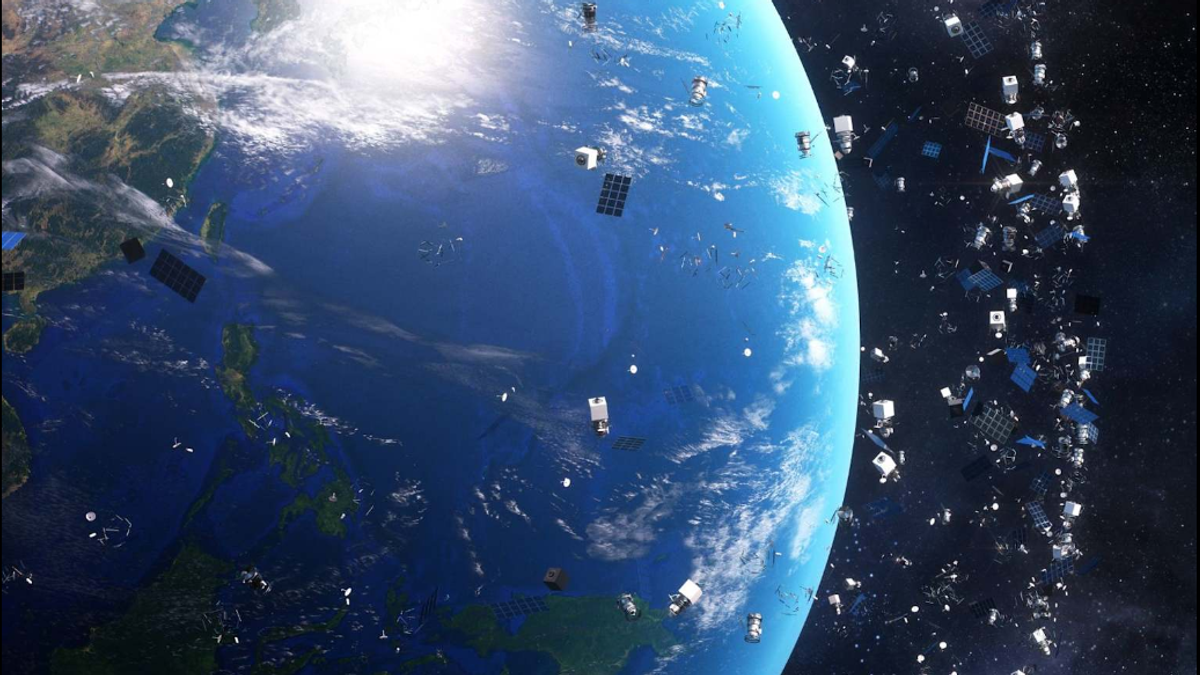
Earth’s rapidly expanding satellite network could face a cascading collision disaster in as little as 2.8 days if operators lose control during a major solar storm or large-scale system failure, according to a new scientific study. The warning highlights growing concerns over congestion in low-Earth orbit as thousands of satellites crowd increasingly narrow orbital paths.
The research, published on December 11 as a preprint on arXiv, introduces a new risk metric known as the CRASH Clock—short for Collision Realization and Significant Harm. Led by Princeton University researcher Sarah Thiele, the study shows that the window to avert disaster has shrunk dramatically from 121 days in 2018, before the rise of megaconstellations.
“We were shocked it was that short,” Thiele told New Scientist, reflecting how quickly orbital safety margins have eroded.
The findings come amid a recent near-collision between a Chinese spacecraft and a SpaceX Starlink satellite on December 9, when the two objects passed within just 200 metres of each other. SpaceX’s vice president of Starlink engineering, Michael Nicolls, said the incident exposed serious coordination gaps between satellite operators.
Low-Earth orbit currently hosts an estimated 14,000 active satellites—more than three times the number in 2018—with SpaceX’s Starlink constellation accounting for roughly 9,300 of them. According to the study, satellites now pass within one kilometre of one another every 22 seconds, sharply increasing collision probability.
In the first half of 2025 alone, Starlink satellites conducted about 145,000 collision-avoidance manoeuvres. Researchers found that even a 24-hour loss of satellite control could carry a 30 percent chance of triggering a catastrophic collision, potentially setting off the Kessler syndrome—a chain reaction of debris that could render parts of orbit unusable for decades.
Powerful solar storms pose one of the greatest threats. A Carrington-level solar event, similar to the 1859 storm that disrupted global telegraph systems, could disable satellite navigation and communication for days while increasing atmospheric drag.
“The immense flow of energy ejected by the Sun may cause damage to all our satellites in orbit,” said ESA space weather coordinator Jorge Amaya during recent simulations, warning that no spacecraft would be fully safe in such an event.
Space debris expert Hugh Lewis of the University of Birmingham said the CRASH Clock captures the fragile state of Earth’s orbital environment. “The more satellites we add, the bigger the collapse when something goes wrong,” he said.
Researchers hope the new metric will prompt urgent changes in satellite deployment and coordination as companies in the US, China, and elsewhere plan to launch tens of thousands more satellites in the coming years.


